Anthropogenic Global Warming–2014.

Skeptical funding

One of the ridiculous claims made by climate alarmists is that skeptics are a well organized group well-paid from the coffers of oil companies and other anti-environment groups.  First of all, climate skeptics are not anti-environment or anti-science.  Secondly, from all that I’ve been able to see, there is no organized funding for climate skeptics.

Driving into the futureOne of the so-called “well-paid” climate skeptic bloggers, Bob Tisdale, has had to retire from full-time climate change blogging.  He had to get a real job. In an update to his post announcing this, he writes:

Something else that was stated in the article Anthony quoted that needs to be addressed.  They falsely claimed that skeptics are some part of an organized effort.  Truth be told, Anthony Watts and I have never met. We’ve talked on the phone, maybe, 3 times. And our email exchanges have been about blog posts.   Someday, it will be my pleasure to meet and shake hands with Anthony Watts, but that time has not come yet

There doesn’t need to be any organization behind climate skeptics. Responding to the nonsense from the climate science community, and from their alarmist parrots, is enough to keep any group of people with common sense busy for years.

97%

The issue of global warming hasn’t gone away.  After all, 97% of climate scientists endorse the consensus that we are causing global warming.

97%Well, that’s not quite true.  One source for the 97%

comes from a non-peer reviewed article describing an online poll in which a total of only 79 climate scientists chose to participate. Of the 79 self-selected climate scientists, 75 agreed with the notion of AGW.  (source)

Another comes from a paper published last May,  Quantifying the consensus on anthropogenic global warming in the scientific literature.  In the abstract, Cook et. al. say that that they looked at peer-reviewed scientific literature:

examining 11,944 climate abstracts from 1991–2011 matching the topics ‘global climate change’ or ‘global warming’. We find that 66.4% of abstracts expressed no position on AGW, 32.6% endorsed AGW, 0.7% rejected AGW and 0.3% were uncertain about the cause of global warming. Among abstracts expressing a position on AGW, 97.1% endorsed the consensus position that humans are causing global warming. In a second phase of this study, we invited authors to rate their own papers.

So, about 7,930 climate abstracts out of 11,944 express no position on the anthropogenic global warming (AGW) consensus and about 4,o14 do.  About 3,897 papers, then, support the consensus.  That’s 32.6% of the papers related to global climate change that were looked at, a far cry from the 97% that is cited way too often in the media.

Extremely likely1

And, of course, the newest version of the IPCC’s (Intergovernmental Panel on Climate Change) Summary for Policy Makers (SPM) is out and, according to it,

It is extremely likely (>95% confidence) that human influence has been the dominant cause of the observed warming since the mid-20th century .

That sounds pretty positive, doesn’t it? Mankind is responsible for most of the warming since the 1950s or 1960s or so.  It’s even more certain than the previous report’s SPM:

Most of the observed increase in global average temperatures since the mid-20th century is very likely (>90% confidence) due to the observed increase in anthropogenic greenhouse gases. [AR4 SPM (2007)]

According to climatologist Judith Curry, the increase in confidence stated in the SPM is not reflected in the text, figures and analyses in the main Working Group One report or when comparing AR5 conclusions to those in AR4.  Ms. Curry writes:

Several key elements of the report point to a weakening of the case for attributing the warming of human influences:

  • Glacier Cruise East GreenlandLack of warming since 1998 and growing discrepancies with climate model projections
  • Evidence of decreased climate sensitivity to increases in CO2
  • Evidence that sea level rise in 1920-1950 is of the same magnitude as in 1993-2012
  • Increasing Antarctic sea ice extent
  • Low confidence in attributing extreme weather events to anthropogenic global warming

In 2007, AR4 projected a warming or 0.2°C per decade. Yet the final draft report of AR5 says:

The rate of warming over 1998–2012 (0.05°C [–0.05 to +0.15] per decade) is smaller than the trend since 1951 (0.12°C [0.08 to 0.14] per decade). (Page 6 of The Physical Science Basis.)

Ms. Curry says, “The IPCC does not have a convincing or confident explanation for the hiatus in warming.”

Temperature projections2

In 2013, it was obvious to many that, in the draft SPM, climate sensitivity was too high, climate models were obviously wrong, and the pause in the rise in temperature was not explained.

The IPCC had only three options – (i) re-run the models and re-draft the whole report, (ii) issue a string of caveats, or (iii) simply bluster on.

gore2After 4 days in Stockholm, debating and wordsmithing, the decision was to… bluster on – with an assertion of increased certainty.

The table of temperature projections is the heart and soul of each voluminous IPCC Assessment Report. Climate alarm stands or falls on the credibility of that table.

Despite its customary obscurantism and spin, the IPCC has now admitted that:

  • a number of its CMIP5 models seriously exaggerate future warming;
  • the climate sensitivity range used for the modeled projections is too high;
  • internal variability is expected to significantly offset warming (for some decades);
  • scientists cannot quantify the influence of sensitivity or of internal variability beyond about 2035; and
  • consequently, the modeled temperature projections are unreliable.

I guess consensus on climate change is just a matter of faith.

_______

References

1 Judith Curry’s IPCC AR5 weakens the case for AGW.
2 Guest essay by Barry Brill on Watt’s Up With That – The IPCC discards its models

Image Credit

Wind Turbines – Driving into the future
AttributionLicense  Some rights reserved by kevin dooley

Polar Ice – Glacier Cruise East Greenland
AttributionLicense  Some rights reserved by christine zenino

Al Gore – Gore Feels the Heat
AttributionLicense  Some rights reserved by jurvetson

2 comments
None

Political Correctness

blackboardGive me a break!

I hear now the board that’s used in a classroom can’t be called a black board or a white board. From what I understand, it’s derogatory to blacks or to whites if you use that kind of descriptive words – it’s either chalk board or marker board.

I guess it’s a good thing that there’s not anyone that might be traumatized by the use of the words chalk or marker.

I don’t know what you would call the boards then.

And I guess we’re supposed to call flip charts something other than that because flip is a word that is offensive to Pilipinos.

Granted, it’s not right to use a word in a derogatory manner like that when using it to refer to an ethnic group.

However, when did black become a derogatory term for blacks and white become a derogatory term for whites?

What am I supposed to call a back flip or flipping a burger (or the finger)?

Sometimes some peoples’ ideas of what is politically correct are just so retarded!

Oh! sorry!

I meant, so MR!

What’s MR?

I understand it’s the politically correct term for mentally retarded.

I guess it’s politically okay to use an abbreviation in this case because they, the MR, can’t spell.

Give me a break!

Our society is carrying politically correctness to ridiculous extremes. Yes, we need to be sensitive to what is hurtful to others.

However, sometimes the folks that think these things up need a reality check.

____________

This post was originally published 10/31/2004

Image credits: Creative Commons License —
AttributionSome rights reserved by BiblioArchives / LibraryArchives; Title: To School again. Blackboard Studies for the New Term; Created by Henri Julien, January 22, 1881

2 comments
None

Unintentional Reinvention.

devils_walking_stick-sWhile trying to move to the Thesis 2.1 theme/framework, something happened where I could edit the new theme all I wanted to and it looked great.

However, when I logged off, the blog looked just like the old theme, no matter what I did, until I finally bollixed it all up to the point that all that was showing was a blank screen.

Nothing worked to recover it and, unfortunately, I ended up writing over the existing database with a nice new, clean and shiny, blank one.

This could be wonderful fun trying to recover the old blog posts. (#sarcasm)

However, I’m not sure that I really want to do that.

My inclination, right now, is to get the format set up and, along the way, find and re-publish some, but not all, of the older material.

______

Update January 8, 2014 — recovered 1234 posts, but without images.

Update 2 – also dealing with a water leak in the supply line in the front yard.

Update 3 – Water line leak is a cracked PVC coupling.  4 feet down slope and 18 inches deep from where the water was coming out of the ground.  I used a fiberglass pipe patch kit to repair it in place.  I’m going to leave to hole open with an incandescent light over it tonight — too tired to move more soil.


9 comments
None

Thesis.

imageIn 2007, I established the domain karensquilting.com and built Karen a web site there. Over the next 6 1/2 years the page and the site remained virtually unchanged.  Karen has never done any web site development work and I only do it on occasion any more.

Karen does have a blog, though, Quilts… etc, where she is quite active and has a good number of regular readers and commenters.  She has 2,238 posts in about 6 1/2 years,  which works out to about 28 posts per month, with an  average just over 7 comments per post in that time

Not too shabby.

She asked me a while back to do something with the old site that we’ve done nothing with in forever.  This week, I’ve been playing around with the Thesis 2.1 framework, so decided to use karensquilting.com to practice with.

I wanted to make sure than anyone who “accidentally” landed on the top domain page would be referred to the blog.  Of course, I could have made that an automatic redirect, but I wanted to see what I could do using Thesis 2.1.

And this is the result:

image

The actual page at karensquilting.com has a grey background around the above box and the links work.

I’ve been using Thesis for several years.  It was initially much easier to work with than other commercial WordPress themes.  In fact, it was much more that just a theme.  It let the user control much more than other themes did without having to actually get into the themes code to do it.

Unfortunately, starting with version 2.0, Thesis did a significant paradigm shift in how it works and in the user interface.  I tried working with it for a while and then just walked away from it, deciding to stay with the earlier version in the meantime.

Coming back to it this time, I guess I approached it differently.  I sat through quite a few tutorials on YouTube and Vimeo, including four where the Thesis creator, Chris Pearson, explained his “vision” of what Thesis is supposed to be.

Developing the page involved very little actual coding.  I think I may have added 2 or 3 lines of CSS and copied some application codes to the appropriate location.   I still have more to figure out for future projects and may have to get into code a little bit.

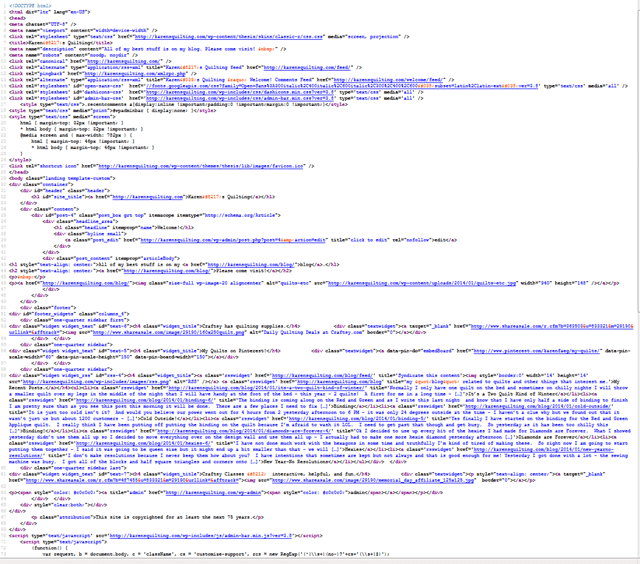
The code below is part of the HTML for the karensquilting.com landing page.  I didn’t directly create any of it, but much of it is a product of what I did in Thesis.

image
0 comments
None

Winter ‘13/14

only 11 more weeks of winter
0 comments
None

Eyes of the Great Depression 125.

Eyes of the Great Depression 125 -- Evicted sharecropper, New Madrid County, Missouri; photo by Arthur Rothstein

[continue reading…]

0 comments
None

Tug and Tow on the Arkansas River.

As viewed from the Pulaski County Pedestrian and Bicycle Bridge – more commonly known as Big Dam Bridge – April 28, 2007.

Three from the Road – no. 12

from the Pulaski County Pedestrian and Bicycle Bridge aka Big Dam Bridge April 28, 2007 - 3

The Big Dam Bridge, near Little Rock,  is an excellent spot for viewing if there is watercraft locking through Murray Lock.

from the Pulaski County Pedestrian and Bicycle Bridge aka Big Dam Bridge April 28, 2007 - 2

Opened in 2006, the pedestrian and bicycle bridge built over Murray Lock and Dam between Murray Park in Little Rock and Cook’s Landing Park in North Little Rock is a major addition to the Arkansas River Trail, connecting several miles of hiking and biking trails on both sides of the river.

from the Pulaski County Pedestrian and Bicycle Bridge aka Big Dam Bridge April 28, 2007


View Larger Map

More info:

Big Dam Bridge
Little Rock / North Little Rock
Related Posts:
0 comments
None

Goodbye VW camper van

imageIn Brazil, the last Volkswagen camper van recently rolled off the only assembly line still building it.  First introduced in 1950, the VW panel van was the company’s second vehicle model, the first being the venerable Beetle.  Sixty-three years later, production is being halted because of new vehicle safety laws taking effect in 2014. The design of the models produced in Brazil vary little from those built when the Sao Bernando production line was opened in 1957.

Related articles:

More on the VW camper van: Wikipedia

0 comments
None

"Just black, please."

I used to drink my coffee sweetened.

On the submarine, one of my watch stations was  upper level engine room (ULER) which is where the coffee urn was.  The other engine room watches as well as the maneuvering room – where they had the controls for engine throttles, electric plant and reactor – could not leave their assigned stations, so they would pass their coffee cup to the ULER guy along with how much sugar and creamer to add.

just-black-pleaseThat was a royal pain and, eventually, whenever I was scheduled for one of the other watch stations, when I wanted a cup of coffee, I would say, “Just black, please.”

Now, that’s the only way I drink it.


Image adapted from Photo on flickr 

Share AlikeAttribution Some rights reserved by Tim Geers (same license conditions apply for this adaptation)Blog post inspired by Will Tea Lose The Battle? on Ramana’s Musings.

0 comments
None

Union.

Three from the Road – no. 11
(plus one)

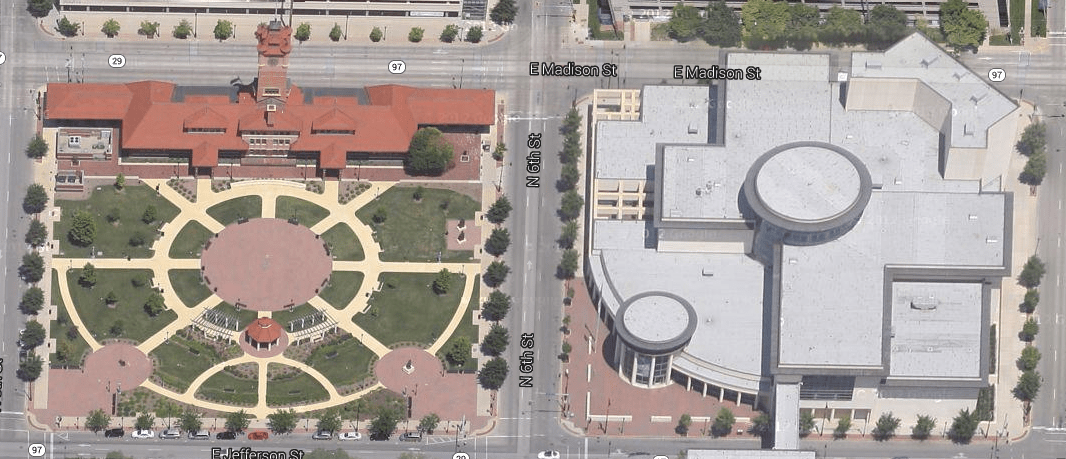
Springfield Union Station, adjacent to the Lincoln Presidential Library, operated for 73 years beginning January 2, 1898.  It now serves as the Abraham Lincoln Presidential Library visitor center.

Springfield, Illinois, September 26, 2008 - 2

imageUnion Square Park  and  Springfield Union Station occupy a city block next to  the Abraham Lincoln Presidential Museum.  The park is the location of many free events and performances.

Springfield, Illinois, September 26, 2008 - 1

A larger than life bronze of Lincoln, A Greater Task, stands in the park.  The title refers to his farewell speech at Springfield as he left to go to Washington after being elected president.

Springfield, Illinois, September 26, 2008 - 3

At the dedication of the statue in 2006, its sculptor, John McClarey, said, “On a cold and rainy day in Springfield on February 11, 1861, Lincoln said goodbye to friends and turned his face toward Washington, D.C. An awesome task lay ahead, as well as the judgment of God and history. Lincoln’s task would be to save the nation and to promise a ‘new birth of freedom’ for all Americans. He would guide the nation through the ‘fiery trial’ of civil war which would test the American character and commitment to the principles that founded the nation. Near the end, he would lay out a road map for peace and reconciliation that would ‘bind up the nation’s wounds’ and restore the ‘mystic chords’ of union so badly broken during that war. Notice in the sculpture that his body language suggests two qualities of leadership that would mark his administration – toughness and compassion. Throughout his administration, he would demonstrate his willingness and capacity for both, and in doing so would transform the nation as well as himself. As always, he hoped that the ‘better angels of our nature’ would guide us. That hope, that ‘greater task’ must be our task as well.”

Springfield, Illinois, September 26, 2008 - 4

Home of Abraham Lincoln from 1837 to 1861, Springfield is the largest city in Central Illinois.  The city includes a number of historic sites associated with Lincoln.

Largely through the efforts of Abraham Lincoln and associates, Springfield became the third capital of the state of Illinois in 1839.

There are at least 39 places named Springfield in the United States.

We visited Springfield, Illinois in September 2008.

More info:
Abraham Lincoln Library and Museum and Union Station/Square
______________
Article source references:
2 comments
None