Shadow trailers and a VW towing a “fifth wheel”

I’m working on recreation vehicle related web pages right now at Haw Creek and, just like anything else of interest, sometimes I come across some strange stuff.

From 1970s ads:

shadow trailerFifth-Wheel Trailers usually hitch onto a pickup-truck cargo bed, but this new Shadow design from Harmon Industries, Warrensburg, Mo. tags onto a passenger-car rooftop. A removable steel plate, bolted to brackets along the roof gutters, take advantage of the roll-resistance built into modern roofs to firmly anchor the trailer hitch. Great maneuverability and easy tow handling are claimed for these rigs. Models of 18, 23, and 27 feet are being produced, and unfinished units are available for extra savings. Shell for the Shadow 18-foot Mini will start at about $1700; price is $6500 for the completed 27-footer fully equipped. Driver reports indicate the design is aerodynamically suitable and does not buffet at speed or in strong winds.

4 comments
None

Eyes of the Great Depression 128.

Undernourished cotton picker's child listening to speeches of organizer -- eyes

[continue reading…]

2 comments
None

Wind… and chill.

Here we go, back into the cold. It was in the mid 60s our area yesterday… 64°F (17.8°C) on our porch.  We’ll be lucky to get up to freezing today.  It was quite blustery during the night.

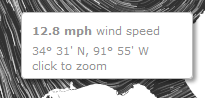
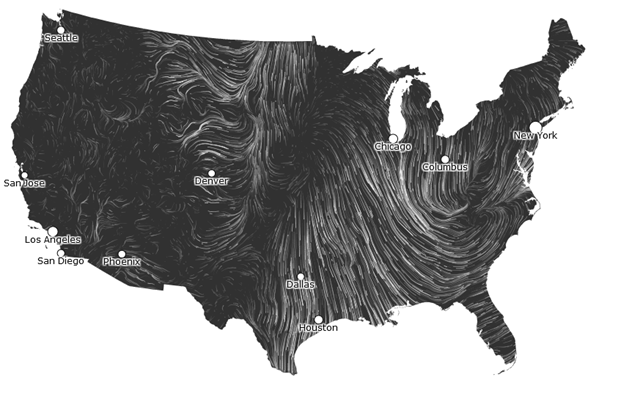
imageThe image below is from a quite interesting animated wind map. It updates on a regular basis and, thus, represents a nice graphical display of what the wind is doing across the nation. Hovering over the image pops up the approximate wind speed and location of the point where you have the cursor and, as the legend says, you can zoom in to the image.  The site does caution that the image is a “personal art project,” that there are no guarantees as to accuracy, and to “Please do not use the map or its data to fly a plane, sail a boat, or fight wildfires.”

image

Karen got a couple of pictures of daffodils and posted them on her blog the other day.  A lot of years, this is a good indication that spring is just around the corner.  This year, however, I’m not going to be counting on it.  The daffodils may just be confused because of the warmth we’ve had the last couple of weeks.

Winter ain’t over.

1 comment
None

Making money online.

BloggersMakeMoneyWe earn a bit from the internet each year, so making money online is possible.

It’s not a lot, but it certainly does pay for our internet access, web host and other incidentals associated with being online. How to seo wordpressAnd, yes, we do pay income tax and FICA (Social Security and Medicare) taxes on those earnings.

Interestingly, much of the earnings have been passive in that I haven’t put any effort for several years into the sites that have earned the most on a regular basis – Haw Creek and a related blog, Haw Creek Out ‘n About.  Both are related to recreational vehicles, travel, and camping.

I’ve started revising and adding to the Haw Creek, working on bringing links to RV manufacturers up to date and adding new content, including the following:

In the last few months, Karen has started bringing in a bit on her blog, Quilts…etc., with ads from Craftsy, a site that has craft supplies as well as online classes related to cooking, photography, sewing, quilting, fine art, knitting, and more.

Perhaps by putting a bit of effort into these passive earning sites, I may be able to boost the earnings a tad.


Photo credits, top two images:
BloggersMakeMoney-small Bloggers Make Money
How to seo wordpress -small How to seo wordpress
Both images: cc_icon_attribution_small Some rights reserved by SEOPlanter

4 comments
None

Eyes of the Great Depression 127.

Migratory Mexican field worker's home on the edge of a frozen pea field. Imperial Valley, California -- eyes

[continue reading…]

0 comments
None

“It’s never been like this before.”

2013-12-06 011edThis was a new kind of storm for Nashville. “It came down harder than I’ve ever seen it rain here,” says Brad Paisley, the country singer, who owns a farm outside town. “You know how when you’re in a mall and it’s coming down in sheets, and you think, I’ll give it five minutes, and when it lets up I’ll run to my car? Well, imagine that it didn’t let up until the next day.” 1

It sure seems like there are more and more news media claims that weather is worse than it has ever been.  “It’s never been this hot for so long.”  “It’s never rained like this before.” “‘Polar Vortex’ set to bring dangerous, record-breaking cold to much of US.2

2011 09 05 004Welcome to entertainment weather.  Often the lead story on the evening news, extreme weather conditions get played for all that they are worth – and more.  It’s something that the viewers can relate to because, often, they, or someone they know, are in the middle of it or they’ve experienced something like it.

However, the weather of today isn’t that unusual.

2009 06 12 042edThe heat waves, cold spells, droughts and heavy rains of recent years have all happened before.  Some people might not remember what it was like in earlier years or, maybe,  the last time it was like that was before they were born, but that doesn’t mean “it’s never been like this before.”

I’ll use Arkansas, where we now live, for some examples of past extremes.

In early July of 1980, we visited family in Arkansas before I got out of the Navy.  The country was experiencing a heat wave, with temperature in Arkansas well over 100°F.  Living in Idaho at the time, our car didn’t have air conditioning, so, for the drive home, we left in the evening to take advantage of the cooler nighttime temperatures.  It was still in the 90s when we went through Kansas City around midnight.

When we moved to Arkansas in the middle of the August, the heat wave was still on.  Most vegetation was brown and dry.  Wildfires were common, smoke often in the air.  The heat wave didn’t break for another month or so.

The heat waves of 2007 and 2012 were uncomfortable, but didn’t approach that of 1980.

Several times in the early 1980s, Lake Dardanelle had significant ice form on its surface in the Illinois Bayou area.  Water from seeps in rock cliffs along highways froze and formed huge icicles.  This winter, during the last so-called “extreme” cold spell of the “polar vortex,” a very thin layer of ice appeared on the Illinois Bayou area of Lake Dardanelle.  Some ice formed on seeps in rocks, but didn’t last long.

On December 3, 1982 much of northern and western Arkansas suffered major flooding due to heavy rains that exceeded 12 inches in 24 hours at some locations on ground that was already saturated from earlier storms. Some parts of the state endured 500-year floods.

“Hay bales were being carried down Illinois Bayou near Scottsville at nearly 20 miles per hour. Near the peak of the event, the force of the floodwater ripped up and scoured away approximately 200 feet of the Arkansas 164 pavement and road embankment on the west side of the river,” remembered U.S.G.S. hydrologic technician Autry Meeker. 3

Downstream on the Illinois Bayou, near where it enters Lake Dardanelle, two bridges on my normal route to work were washed out.  North of there, on the highway heading home that evening in heavy rain, I dodged firewood that had washed onto the road.

Raw footage from 1982 flooding and tornados:

On the “polar vortex” angle:

The cold snap triggered by the polar vortex, the low-pressure weather pattern that rammed into the United States from the Arctic the week of Jan. 5, was pretty paltry compared to cold waves in the past four decades, said Bob Henson, a meteorologist at the National Center for Atmospheric Research in Boulder, Colo.

“If you look at the number of days it stayed cold all day and all night, this cold wave was much briefer than past cold waves,” Henson told LiveScience. “There are many ways to measure a cold wave, but the brevity of this one just jumps out.” 4


1 National Geographic – Extreme Weather, September 2012
2 Fox News – ‘Polar’ vortex…, January 4, 2014
3 NWAonline (saved at USGS) –  Floods Flushed State’s Rivers 20 Years Ago, December 1, 2002
4 LiveScience – ‘Polar Vortex’ Event Paltry Compared to Past Freezes, January 15, 2014

0 comments
None

Big Guns.

Three from the Road – no. 13

Fort Moultrie, Sullivan’s Island, South Carolina, June 14, 2012

Fort Moultrie, Sullivan's Island, South Carolina, June 14, 2012 - 3

32-pounder, Model 1829

Of the heavy guns manufactured in the US during the first half of the 19th century, the 32-pdr smoothbore was by far the most prolific, with a variety of models and lengths.  The Navy alone purchased at least 2,947 of ten different types.  Well suited for shipboard use, the Model 1829 was oftentimes used by the Army as a seacoast gun in coastal forts.  Produced from 1829 to 1839, it was the most widely produced 32-pdr in America.  With the introduction of ironclads during the Civil War, the 32-pdr smoothbore became virtually useless against these new, nearly invulnerable targets.

The pair of 32 pdrs on display inside Fort Moultrie were obtained from the Colonial National Historic Park in December 1963.  Formerly mounted in the Yorktown National Cemetery, they were partially buried in concrete with their muzzles pointed upward.

Fort Moultrie, Sullivan's Island, South Carolina, June 14, 2012 - 4

10-inch Confederate Columbiad.

A smoothbore, seacoast gun, this gun was manufactured  by Joseph Reid Anderson & Co. (Tredegar Foundry) in Richmond.  By 1886, ten of the original 15 columbiads were still present on Sullivan’s Island, unmounted and unused.  Over the years, six were apparently sold as scrap metal. The remaining four were used as monuments along Middle Street, half-buried with their muzzles pointing upward.  Eventually the guns were dug up and mounted on concrete pedestals in the 1930s.  The two nearest Fort Moultrie were removed in 1975 by the National Park Service and the pedestals destroyed.  One was eventually mounted on cannon row and and the other inside the fort.

Fort Moultrie, Sullivan's Island, South Carolina, June 14, 2012-2

1898 4.72-inch Armstrong rapid fire gun.

A rapid fire seacoast rifle, this gun was manufactured in Elswick, England.  The original guns on Battery Bingham were likely scrapped during World War II to reuse the metal.  The current gun was originally mounted in a two-gun rapid-fire battery on Narragansett Bay in Rhode Island.  It was received in a trade in 1977 from the National Guard Armory in Westerly, Rhode Island.


More info:


Fort Moultrie

Sullivan’s Island

Notes:


1.  Information for this post comes from The Historic Guns of Forts Sumter and Moultrie by Mike Ryan, May 1997

Related Posts


0 comments
None

Lost and Found–update on blog recovery efforts.

09-mar-25Only 5 days – seems much longer since I overwrote the database for this blog with a nice new, clean and shiny, blank one. (see Unintentional Reinvention)

Fortunately, I had saved a backup of the old database just before I did the overwrite.  At first it didn’t seem like I was going to be able to import it as the WordPress importer won’t import files bigger than 10 mb – which this one was.

I tried several other options, to no avail.

Then, I simply opened the backup file in Windows Notepad and edited it to create two smaller files, each small enough to upload – and got all of the content back… almost.

All that were missing were most of the images and a large percentage of the comments.

Unfortunately, I not only wrote over the database, but I had deleted all of the WP associated files and directories on the server – including the uploads directory… where all the photos are stored.

So, at this point in the recovery, my blog that is so heavily slanted to pictures had no pictures.

Fortunately, I had saved all non-database files to an external hard drive last summer and, at that point, I had a lot of posts scheduled in advance, so I was able to restore the greatest majority of the images.  All images back to beginning of  December through also been recovered.

For recent years, I think I’m missing images from 50 or so posts.  I’ll be able to find most of those on Pinterest.

The only material that I will be unable to get back, I think, is the comments.

I’ll be looking into a good blog backup plugin, perhaps Backup Creator.


Photo credit:

Title: 09-mar-25
Attribution Some rights reserved by sashafatcat

2 comments
None

Anthem for Doomed Youth

Supports going up after battle to relieve the front trenches

Wilfred Owen
1893-1918

What passing-bells for these who die as cattle?
Only the monstrous anger of the guns.
Only the stuttering rifles’ rapid rattle
Can patter out their hasty orisons.
No mockeries now for them; no prayers nor bells;
Nor any voice of mourning save the choirs,
The shrill, demented choirs of wailing shells;
And bugles calling for them from sad shires.

What candles may be held to speed them all?
Not in the hands of boys, but in their eyes
Shall shine the holy glimmers of goodbyes.
The pallor of girls’ brows shall be their pall;
Their flowers the tenderness of patient minds,
And each slow dusk a drawing-down of blinds.


Poem from abandoned blog A Selection of Poetry—the blog retrieved January 2014 from Internet Archive – originally posted April 8, 2006.


“Orison” is from Latin for prayer

Supports going up after battle to relieve the front trenches – Taken some time in 1918, UK National Media Museum on Flickr’s The Commons
No known copyright restrictions No known copyright restrictions

0 comments
None

Eyes of the Great Depression 126.

Citizens of Zinc, Arkansas, a deserted mining town; photo by Ben Shahn -- eyes

[continue reading…]

0 comments
None