Stay on the path…

image

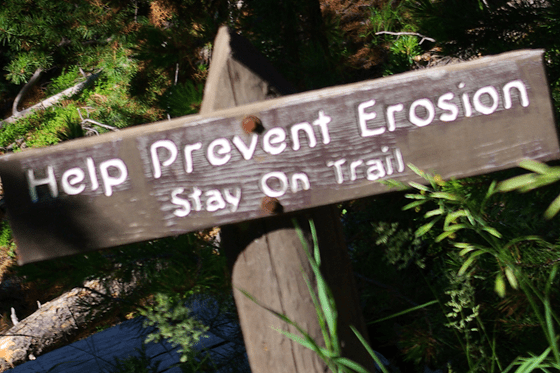
On public trails where there is a lot of traffic, straying off the trail can lead to damage to the surrounding area.  On very steep trails it can also be quite dangerous.

Yesterday, we took the  trail to the brink of the Lower Falls of the Yellowstone River.  The trail is quite steep, dropping over 600 feet in about 3/8 of a mile, according to the trail guide, “not recommended for those with heart, lung, or other health conditions.” 
image

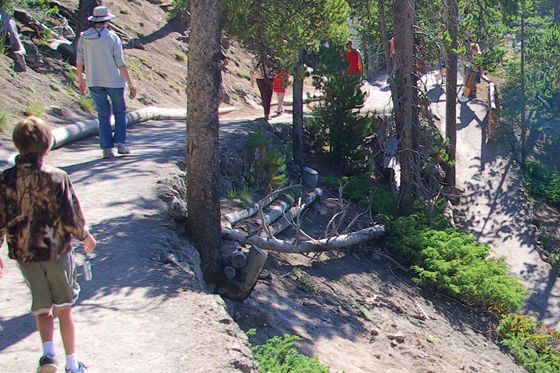
For the trail to drop so far in such a short distance, there are many switchbacks and it can be tempting to take shortcuts especially if you’re in a “rush, rush, rush – we’ve only got ___ days to see everything! in our trip.”

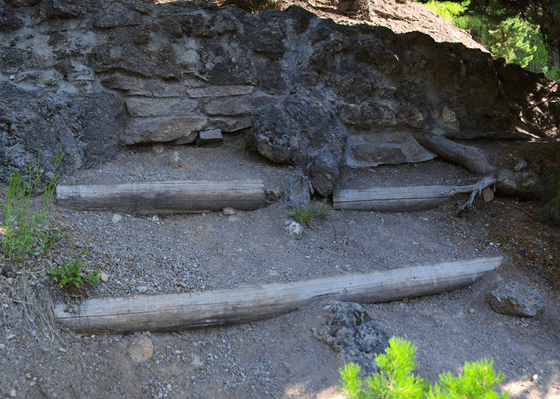
And I’m sure it’s very tempting to many kids, teens and immature young adults.  I heard one youngster exclaim to his parents, “Oh, wow, stairs! We could have taken a shortcut,” referring to logs that had been placed in an eroded area to limit the damage.  I wasn’t surprised to see kids taking shortcuts on the switchbacks, though the greatest majority of them stayed on the trail.
image

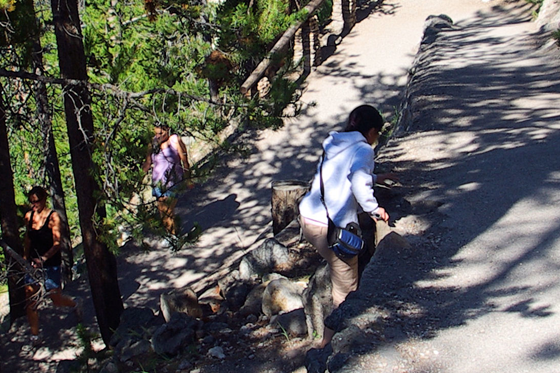
But, it did surprise me to see a couple of adults 

picture

climbing between the switchbacks – and they weren’t young adults, either.  At a guess, Id say they were in their late thirties or early forties.

And, I’m pretty sure that they were not American – they were speaking something other than English –, not that it matters, because everyone should follow the rules. 

Human caused erosion:

2010 08 05 069panoed

Humans causing erosion:

image 2010 08 05 a 010ed
0 comments
None

How we are posting in Yellowstone National Park

Most of Yellowstone does not have wifi.  Neither is there any cellular phone service through most of the park. 

When we want to publish posts to our blogs, we prepare the posts in advance.  Then, as we are exploring the park, we include in our plans for the day a stop where there is cellular phone service and where we can use our phones’ mobile hot spot feature.

003ed  003phoneWe found a really good spot on the second floor of the Old Faithful Inn lobby area.

The cord to the phone is not necessary for mobile hot spot use.  It is a USB cord that is being used, in this case, to provide power to the phone from the computer battery.

Since we are away from internet access so much this trip, we are using Windows Live Writer to prepare our posts and are scheduling some posts to automatically publish in subsequent days.

1 comment
None

On the Brink

Lower Falls of the Yellowstone River – drops into the Grand Canyon of the Yellowstone.

Each photo is a composite image from 3 or more photos.

2010 08 05 a 084panoed 2010 08 05 a 015panoed 2010 08 05 a 087panoed
0 comments
None

Black Pool

I know, I know.  It’s not black.  That is the name, though, of this very hot pool.

It used to be black.  Lower water temperature allowed thick mats of dark green and brown thermophiles (heat-loving microorganisms) to grow in the pool, causing it to appear black.  In 1991, the water temperature rose, killing the thermophiles.  It also erupted as a geyser that summer and several times the following winter.  Black Pool is now a quiet and beautiful pool.

2010 08 04 e 006panoed

Posted from Old Faithful Inn, Yellowstone National Park

0 comments
None

National Historic Trails Interpretive Center

On our way from Douglas, Wyoming, to Pathfinder Reservoir, we visited a couple of locations in the Casper area.

One of these was the National Historic Trails Interpretive Center.

The Pony Express, a larger than life bronze sculpture, outside the center:

Pony Express, bronze statue, National Historic Trails Interpretive Center., Casper, Wyoming

The center provides a lot of information and displays related to the historic westward trails, including an automatic presentation that spotlights figures in the center’s theater at appropriate points.

One drawback of the theater setup is there is no door between the entrance area and the theater and light reflects from the theater.

image

From the National Historic Trails Interpretive Center website:

The National Historic Trails Interpretive Center is a cooperative partnership between BLM, the National Historic Trails Center Foundation and the City of Casper. The Trails Center interprets the significant role of the area’s historic trails in the history of the United States, and seeks to promote public understanding of both America’s western Native Cultures and historic westward expansion while highlighting BLM’s role as active stewards of public lands.

Nearly 500,000 people traveled the Oregon, Mormon, California and Pony Express Trails between 1840 and 1870.

Inside the building, the facility’s theatre showcases composite characters traveling the trails: Native Americans, explorers and mountain men, emigrants and Pony Express riders. These diorama figures represent Native cultures and the thousands of people who emigrated west.

An original 18-minute multi-media program, Footsteps to the West, is shown in the theatre on a regular basis.

The Trails Center features seven exhibit galleries:

  • Ways of the People 
  • The U.S. Looks West (mountain men & explorers)
  • The Oregon Trail
  • The Mormon Trail
  • The California Trail
  • The Pony Express Trail
  • The Trails Today

All of these galleries feature hands-on exhibits as well as informational panels which tell the story of those who lived, worked and traveled these national historic trails.  

image

The Center is located at the blue pin on our travel route map.

0 comments
None

Heading into Yellowstone

Tomorrow morning, we’ll be heading into Yellowstone National Park, where we will be camping for the next week.

Our route through August 4, 2010

Internet access may not be available in the campground, so posting and checking email/blogs may be sporadic.

In this instance, I can post a few pictures of what we are going to see on our way in – the following photos were taken in September, 2007.

The Roosevelt Arch at Gardiner, Montana, is at the north entrance to the park.  It cost $10,000 when it was built in 1903.  President Teddy Roosevelt laid the cornerstone.  The arch is 50 feet high, and the main opening is 25 feet wide.  At the top of the arch are these words: "For the benefit and enjoyment of the people"  – words taken from the 1872 act that created the park.

Roosevelt Arch, Gardiner, Montana, Yellowstone National Park

Just inside the park, we’ll be crossing the 45th parallel.

45th parallel, Yellowstone National Park

We may get to see some “town elk,” known to “take over” the town of Mammoth, Wyoming, during the fall mating season.

elk in Mammoth, Wyoming, Yellowstone National Park

It’s possible we may see some coyotes during our travels around the park.  We saw several when we were there in 2007 and at least 5 in Grand Teton National park last month.

coyote, Yellowstone National Park

We’ll almost certainly see some buffalo – and foolish tourists!

Way too close, buffalo, Yellowstone National Park

And some thermal features, though we may not stop tomorrow.

 thermal feature, Yellowstone National Park

And, of course, our 103 mile drive will likely be delayed by traffic jams.

Buffalo traffic jam in Hayden Valley, Yellowstone National Park

But we’ll get set up in time to do a little exploring and get some new pictures.

In the meantime, I’ll have some posts on some the places we’ve been, just in case we can’t get to the internet (or are busy doing things other than blogging 😉 )

0 comments
None

Grizzly Country

image

View to the east from our camp site:

KOA, Livingston, Montana

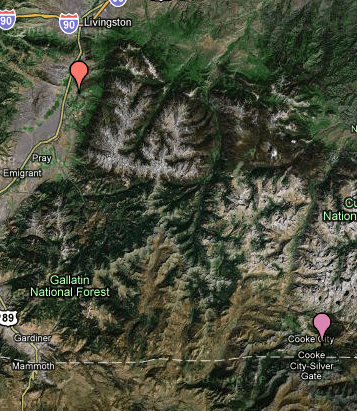
We are currently camping at a commercial campground south of Livingston, Montana, indicated by the top left marker on the map.

The lower right marker is the campground where last week’s bear mauling occurred.  It’s about 50 miles from us as the crow flies, but nearly 200 miles by road.  The terrain between here and there is some of the most rugged in the United States.

The bears involved in the incident were a mother bear and her three yearling cubs.  All were captured.  The sow was euthanized and the three cubs were relocated to Zoo Montana in Billings, where they will be quarantined for 30 days to ensure that they are disease free.

The three cubs were underweight for their age, possibly malnourished, and still in their winter coats.  The sow was also underweight and had not yet shed her winter coat.

Tests on the body of the adult grizzly show that she was underweight, but not malnourished.  She was about ten years old and should have weighed 300 to 400 lbs., but only weighed 225 lbs. No injuries, tumors or other obvious signs of illness were found.

There is plenty of food in the area and other bears there show no sign of malnourishment.

I think it is likely that unusual hunger played a role in the incident, but officials won’t commit to that, saying that it’s possible they may never know what caused the attack.

When we are in Yellowstone, we generally don’t go on the same kind of hikes that we do in other areas.  Most of our walking is done in areas like hot springs, geysers, and waterfalls where there are plenty of other people and where it is less likely that there will be bears.

All three of the people attacked were in tents.  When bears become an issue around campgrounds in Yellowstone, those campgrounds are closed to tenters and RVers with soft sided campers.  Our camper is hard sided.

The bear danger where we will be isn’t any higher than it normally is there.

Not to worry.  😉

1 comment
None

Montana!

We’ve been in Montana since Wednesday afternoon. 

We drove from west of Stanley, Idaho to a small campground just over the state line in Montana (green line), where we stayed 3 nights.  Most of that day’s travel followed the meandering path of the Salmon River.  We didn’t have reservations anywhere and planned to start checking national forest campgrounds as soon as we got into Montana.  Mays Creek Campground was the first one we came across.  It had nice spots and wasn’t busy, so we didn’t look any further.

2010 trip

Enjoying a camp fire and the sunset (picture from Karen’s blog):

Enjoying a camp fire and the sunset  in Montana

Today we traveled to just south of Livingston, Montana (red line).  We’ll be here for three nights and then we’ll be moving into Yellowstone National Park.  The park is about an hour south of us and we have at a campground on the north shore of Yellowstone Lake.

Yellowtone National Park
1 comment
None

Ayers Natural Bridge

On July 10, we had a picnic and spent an hour or so at Ayers Natural Bridge.

Ayres Natural Bridge Park is a county park in Converse County, Wyoming

Ayres Natural Bridge Park is a county park in Converse County, Wyoming. Occuppying 150 acres (0.6 km²) southeast of the town of Glenrock.

Over the course of millions of years, a bend in LaPrele Creek (originally known as Bridge Creek) wore away at a wall of solid rock, creating a natural opening. The creek eventually shifted course through the opening, forming a 30-foot (10 m) high and 50-foot (15 m) wide arch, today known as Ayres Natural Bridge.

Located about a mile (2 km) south of the Oregon Trail, the Natural Bridge was often visited by emigrants traveling west. It is considered one of Wyoming’s first tourist attractions. In 1843, a pioneer described it as "a natural bridge of solid rock, over a rapid torrent, the arch being regular as tho’ shaped by art."

The park is free to visit. There is a small campground in the park, as well as open picnic areas and covered tables. It is opened from April through September from 8 a.m. to 8 p.m., with registered campers allowed to stay overnight. No pets are allowed in the park.

(Source: Wikipedia)

1 comment
None

Danger in our national parks

image image image image

Our national parks are places where nature is preserved – and nature can be dangerous.

We have been away from news  internet service for about 4 or 5 days.

A while back, I subscribed to press releases from the National park Service.  While going through those that had accumulated, I noticed that there were several fatalities .  Then, while I was putting this post together, I was told about bear maulings in the Yellowstone area.

Nature can be dangerous.

Some people get hurt or killed because they don’t follow the rules.

Sometimes, though, natural events are the cause.  The bear maulings near Yellowstone appear to be very unusual, where no one did anything wrong.  It appears to be a rogue bear.

Links on each of the picture go to the applicable news piece.

0 comments
None