Coal miner’s child taking home kerosene for lamps.–The Bitter Years 003

Company houses, coal tipple in background. Pursglove, Scotts Run, West Virginia. September, 1938. (photographer Marion Post Wolcott) 30180-M2

Coal miner's child taking home kerosene for lamps. Company houses, coal tipple in background. Pursglove, Scotts Run, West Virginia.–The Bitter Years 003

The Bitter Years, in 1962, was Edward Steichen’s last exhibition as Director of the Department of Photography at New York’s Museum of Modern Art (MoMA). The images in the exhibition were personally selected by Steichen from 270,000 photos taken for the Farm Security Administration by a team of photographers employed between 1935 and 1941 to document (primarily) rural America during the Great Depression.

On Flicker: Coal miner’s child taking home kerosene for lamps

0 comments
None

Coal miner’s child. Omar, West Virginia.–The Bitter Years 002

October, 1935. (photographer Ben Shahn)

Coal miner's child. Omar, West Virginia. October , 1935, Ben Shahn–The Bitter Years 002

The Bitter Years, in 1962, was Edward Steichen’s last exhibition as Director of the Department of Photography at New York’s Museum of Modern Art (MoMA). The images in the exhibition were personally selected by Steichen from 270,000 photos taken for the Farm Security Administration by a team of photographers employed between 1935 and 1941 to document (primarily) rural America during the Great Depression.

0 comments
None

Hung as a Horse Thief.

I haven’t done any genealogy for quite a long while.  One ancestor, a 5th great-grandfather, Francis Hopkins, was apparently on the losing side of the American Revolutionary War.  He didn’t make it to the end of the war as he was “lynched” as a horse thief. The narrative below is from History of Southwest Virginia, 1746-1786: Washington County, 1777-1870 by Lewis Preston Summers, published 1903.

Mike> Marilyn>Vivian>Samuel Hopkins>James Francis>Eldridge>William>Francis Hopkins b: Abt 1720 d: abt 1778

Horse Thief“At this time there lived in Washington County two men by the names of FRANCIS HOPKINS & WILLIAM HOPKINS. FRANCIS HOPKINS was a counterfeiter and, at the May term of the County Court in the year 1778, he was tried by the court on suspicion of his having counterfeited, erased and altered sundry treasury notes; the currency of this Commonwealth, knowing the same to be bad. He was found guilty, fined fifty dollars lawful money of Virginia, sentenced to six months in prison, and was ordered to be confined within the walls of the Fort at William Cocke’s (now C.L. Clyce’s), on Renfro’s Creek, alias Spring creek, until the county goal was completed. He was conveyed to Cocke’s Fort, but, within a short time thereafter, made his escape and began a series of very bold and daring depredations upon the Whig settlers of the county. He organized a band of Tories, whose occupation was to steal the horses of the settlers and intimidate the citizens whenever possible. He went so far as to post notices at and near the home of Colonel William Campbell, warning him that if he did not desist from his prosecution of the loyal adherents of George III, a terrible calamity would befall him, either in the loss of his property or his life.

“On a quiet and beautiful Sabbath in the spring time of the year 1780, General Campbell accompanied by his wife (who was a sister of Patrick Henry), and several of their neighbors, attended a religious service at a Presbyterian house of worship known as Ebbing Spring Church in the upper end of this county. As they were returning to their homes they happened to be conversing about the audacity of the Tory who had been so bold and defiant in his declarations and was suspected of having posted these notices above referred to. Just as they arrived at the top of a hill, a short distance west of the present residence of Colonel Hiram A. Greever, they observed a man on horseback on the opposite hill, coming
towards them. General Campbell was riding beside his wife, with an infant on before him. One of them remarked that the individual meeting them was the Tory of whom they had been speaking, probably now on a horse-stealing expedition, as he was observed to be carrying a rope halter in his hand. Hearing this, Colonel Campbell, without halting, handed the infant over to its mother and dashed out in front. Seeing the movement and recognizing the man whom he so much feared and hated, the Tory wheeled his horse and started back at quite a rapid gait, pursued at full speed by Colonel Campbell and one of the gentlemen of the company, whose name was Thompson. Never, it may be presumed, either before or since, has such a dashing and exciting race been witnessed upon that long level between the residences of Colonels Greever and
Beattie. As they reached the branch at the base of the hill a little west of Colonel Beattie’s, Colonel Campbell dashed up alongside the fleeing Tory, who, seeing that he would be caught, turned short to the right down the bank and plunged into the river. As he struck the water, Colonel Campbell, who had left his companion in the rear, leaped in beside him, grasped the Tory’s holsters and threw them into the stream, and then dragged him from his horse into the water. At this moment Mr. Thompson rode up. They took their prisoner out on the bank and held what may be termed a drum-head court. The Tory,
who, bad as he was, had the virtue to being a brave, candid man, at once acknowledged the truth of the charge preferred against him and boldly declared his defiance and determination to take horses wherever he could find them. But he was mistaken in his man, for in less than ten minutes he was dangling from the limb of a large sycamore that stood upon the
bank of the river, the stump of which was to be seen a few years ago, and may be there yet for aught the writer knows” *
* written by Charles B. Coale.

4 comments
None

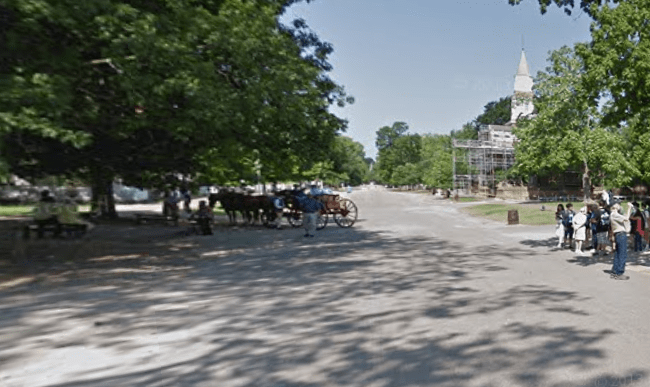
Williamsburg, Virginia–154 years apart

28675968376_9601c391ea_tSo I was dinking around with images of some watercolors from the Civil War by William McIlvaine, Jr. and I thought I recognized one of the locations and knew, if I was right, that the changes over 154 years would be much less than would be seen by most other places.

Colonial Williamsburg’s 301-acre (122 ha) Historic Area includes buildings from the eighteenth century (during part of which the city was the capital of Colonial Virginia), as well as 17th-century, 19th-century, Colonial Revival structures and more recent reconstructions.  (Wikipedia)

This watercolor by a 49-year-old McIlvaine is of Williamsburg’s Duke of Gloucester Street in 1862. During the Civil War, McIlvaine served as a member of the New York 5th Regiment of Volunteers, so his paintings were of the locations where he served.

Williamsburg, Virginia, 1862

This Google Street’s image of Williamsburg’s Duke of Gloucester Street is from as close as I could match to the spot where McIlvaine did the watercolor above . The Church is Bruton Parish Episcopal Church.

Image2
2 comments
None

Quake!

Earthquake, Arkansas, July 27, 2016

Quite a non-event, really.

Yesterday evening, we felt, and heard a bump – or thump – or muffled boom – that was noticeable, but not lasting.  My initial impression was  that it was a sonic boom.

It turns out that what we actually experienced was a small earthquake, with an epicenter 2.45 miles 3.9 (km) north of us and, according to the US Geological Survey Earthquake Hazards Program, was a magnitude 2.8 at a depth of 4.3 miles (7 km) .

Tiny – no big deal.

Of course, now it begs the question, what about all those others in the past that we attributed to sonic booms?  Scientists speculate that some ‘booms’ are probably small shallow earthquakes that are too small to be recorded, but large enough to be felt by people nearby1.

The following trace was recorded at Cathedral Cave in the Onondaga Cave State Park in Missouri.  Time 0:00:00 is the time of the event.  The colored marks are the times that various seismic waves reached the seismic monitoring equipment there. The location of an earthquake – and its depth are determined by comparing the times with other seismic stations.

Earthquake, Arkansas, July 27, 2016, seismograph trace from Cathedral Cavern, Missouri

The following map shows 3526 magnitude 1.0 or higher earthquakes in a square centered on Arkansas  recorded since we moved here in August, 1980. There were only 632 at or above magnitude 2.5, 57 at or above 3.5, and 1 at or above magnitude 4.5.   In the same period, USGS only has 53 quakes recorded of a magnitude less than 1.0 in the same region.

3526 magnitude 1.0 or higher earthquakes in a square centered on Arkansas  since August 1980

During the same period, the following map shows 6338 earthquakes in the region of the New Madrid fault.

8338 magnitude 0.0 or higher earthquakes in a square centered on the New Madrid Fault since August 1980

In this part of the country, earthquakes are more of a curiosity than a real danger.


1. Earthquake Booms, Seneca Guns, and Other Sounds (USGS)

4 comments
None

Seedol Kelpamalt Tablets

Thousands of thin, sickly, tired out folks report Kelpamalt, new mineral Concentrate, adds extra lbs, new strength and energy the first week.  (click on image to go to larger version)

Thousands of thin, sickly, tired out folks report Kelpamalt, new mineral Concentrate, adds extra lbs, new strength and energy the first week.

Vintage ad from April 1937 Popular Science

2 comments
None

Not Following the Rules in Yellowstone can be Fatal

thermalEarlier this week, there was another senseless tragedy in Yellowstone.

People do stupid things all of the time.  Yellowstone is not a place to do stupid.

Yellowstone can be dangerous – especially if you don’t follow the rules.  Some people, a small percentage of those who visit, violate the rules, mostly without consequences. However, there can be consequences, ranging from a ranger’s verbal reprimand or an actual citation for violating the rules to far, far worse.

Yellowstone mud potOne of the worst possible consequences of not following the rules in Yellowstone occurred on Tuesday, June 9, 2016.  Colin Scott, a 23-year-old from Oregon, and his sister were “exploring” Norris Geyser Basin, wandering 225 yards from the safety of the boardwalks – about an eighth of a a mile – when Colin slipped and tumbled into one of the thermal features, an unnamed acidic mud pot, according to one of the park rangers (see video, below). Recovery efforts were ceased after it was determined there was nothing left to recover other than a few personal effects.

Norris is the hottest thermal area in Yellowstone.  In places, there is but a thin crust layer over superheated, acidic water beneath – even well away from the visible thermal features of the basin.

follow the rulesIn 2014, while we were exploring Norris Geyser Basin from the safety of the boardwalks and well-marked trails, I took a photo of a man who was exploring away from the posted and demarcated safe areas.  Just a short time later, I took another photo, this one of of  a hole in the crust that was about as far off the trail as the guy in the picture had been. While the surface of the thermal areas may appear safe, looks can be very deceiving .

On June 6, 2016, at Upper Geyser Basin, home to Old Faithful, a thirteen-year-boy and his father were burned at a thermal feature, with the son subsequently  hospitalized and the father refusing treatment.

“Directly below the surface and in areas where there are thermal features, there can be a lip over the top of the feature that hides boiling hot water below it,” said park spokeswoman Charissa Reid. “So it’s very dangerous to walk off the boardwalk in the thermal areas. Not only is it illegal, but it’s also unsafe. In addition to that, it can damage the thermal features and encourage others to walk off trail by leaving foot prints in the geyserite1 as well, so it is illegal and we do enforce that regulation pretty strongly in the park.“

The tragic fatality at Norris Geyser Basin is but the latest of Yellowstone rule violations that have made it to the internet and media this year.  Two Canadians face charges after picking up what they thought to be an abandoned bison calf, which had to be euthanized when the herd refused to recognized it after park officials tried to return it.  Members of a Canadian film group were cited for walking off the board walk up to the edge of Grand Prismatic Spring, caught after their video of the adventure surfaced on the internet. And a woman was recorded trying to pet a bison near Old Faithful.


1. Geyserite is a form of opaline silica that is often found around hot springs and geysers. Botryoidal geyserite is known as fiorite. It is sometimes referred to as sinter.

2 comments
None

Memorial Day

3 comments
None

Before Shots Were Fired.

Art on Sunday #13

Fort Sumter before the Civil War by Bvt. Brigadier General Seth Eastman. (Collection of the U.S. House of Representatives)

Fort Sumter before the Civil War by Bvt. Brigadier General Seth Eastman.
(Collection of the U.S. House of Representatives)

Here, the fort in Charleston, S.C. is intact, but it is surrounded by choppy waters and threatening clouds. The wrecked sailboat in the foreground further foreshadows the coming violence.

Fort Sumter was “one of a series of coastal fortifications built by the United States after the War of 1812— a war that had shown the gross inadequacy of American coastal defenses. The fort belonged to what has come to be known as the Third American System of coastal defense, embodying ‘structural durability, a high concentration of armament, and enormous overall firepower.’ “ (Fort Sumter – Anvil of War, US National Park Service 1984).

Eastman was a career infantry officer and accomplished artist, graduating 22nd out of 46 in the 1829 class at West Point. In 1833, he was assigned to the United States Military Academy at West Point as an assistant instructor of drawing (as used in mapmaking and illustration) where he served for seven years. Between 1849 and 1855 he served in Washington DC as a illustrator for “Historical and Statistical Information Respecting the History, Condition and Prospects of the Indian Tribes of the United States”, published in six volumes between 1852 and 1857. He was placed under orders to the Secretary of the Interior, September 1867, to February 1870 during which he completed a series of nine paintings for the U.S. House of Representatives depicting American Indian life. In 1870 he was commissioned by Congress to create a series of paintings of important U.S. fortifications. He completed 16 paintings before his death in 1875 and was finishing the 17th, West Point, when he died.

2 comments
None

Game Show Contestant

Houston Light and Power Prep Bowl, CE King Contestants, 1969-70 school year

Houston Light and Power Prep Bowl, CE King Contestants, 1969-70 school year

 It didn’t last long – just one show, where we we eliminated from the competition – but, hey, how many people can actually say they were on a television game show? Even though it was only a local TV station , KPRC-TV did – and does – serve one of the largest conventional television markets in the country. It was so long ago, though, – 46 years – that there is almost nothing on the internet related to the HL&P Prep Bowl.

While I don’t remember much of the specifics about the competition, I do remember a little.  I did provide some of the answers to questions and it was hot under the studio lights, which were so bright that I could hardly see the audience in the bleacher-like seating.

The competition was held during the 1969/70 school year when Peggy Bulanek, team captain, Paula Krumpelbeck and I were seniors, as I recall, and Pat Kotal and Jerrie Stahl were juniors. It was Peggy’s second time in the competition and the first for the rest of us. Our faculty sponsor, if that’s the right word for it, was history and social studies teacher, Earl Richardson.

I can’t say that we were really a team as I understand the concept today.  I don’t remember any sort of practicing or preparing for the competition.

I honestly do not know how I was selected to be on the team.  Academically, I certainly wasn’t a standout and actually got a “D” – barely passing, and my lowest grade while in high school – from Mr. Richardson one semester.  Up to that point, I had coasted my way through high school, and, during my senior year, I got out early each day so I could go to work under some sort of student-to-work program that they had at the time.  At graduation, I was barely in the top half of my class – as I recall, about 55 out of around 105.

I joined the Navy a couple of years later and never went back to the Houston area, other than three short visits in 1972 – 73 and a couple of days in 1986.  I heard that Mr. Richardson passed away sometime in the last few years, but know nothing of any of the others since I graduated from CE King High School.

(Update: I’ve since learned that, on the date this was first published, February 13, 2016, all of us except Mr. Richardson were still living. Pat Kotal and I exchanged information in a Facebook group. I later read on the Facebook group that Jerrie Stahl was ill with pancreatic cancer and passed away the next day, February 14.)

6 comments
None