For many Americans, the Great Depression starts with the stock market crash of October 1929.
In the Arkansas hill country, it was not that simple.
 For families scattered across the Ozarks and Ouachitas, hard times began years earlier. Farm prices had collapsed after World War I. Timber operations were shrinking. Small towns depended on farmers with less and less money to spend. Roads were poor, schools struggled for funds, and cash was often scarce even during what the rest of the country remembered as the prosperous 1920s.
For many, times had always been hard.
Then came the Depression.
But one of the most important things to understand about Arkansas’s hill country is that not everyone experienced it in the same way.
Some people were ruined.
Others lost jobs, farms, savings, or opportunities they had spent years building.
And some families, particularly those living on relatively self-sufficient farms, might have looked at the national calamity and wondered exactly when the Depression was supposed to have begun.
They had been poor all along.
The Prosperous Twenties Weren’t Prosperous Everywhere
The popular picture of the 1920s is one of automobiles, radios, jazz, booming factories, rising stock prices, and rapidly expanding consumer culture.
That America certainly existed.
Much of rural Arkansas lived in another world.
Arkansas remained overwhelmingly agricultural, and the farm economy suffered badly after the artificial prosperity produced by World War I disappeared. Agricultural prices collapsed beginning around 1920.
Farmers who had borrowed money during the better years suddenly found themselves producing crops worth far less than expected. Land values weakened. Debt became harder to service.
Arkansas eventually became one of the most heavily indebted states in the country on a per-capita basis.
The problem spread far beyond farmers.
The farmer who could not sell his crop could not buy shoes at the general store. The merchant could not pay the wholesaler. The wholesaler cut orders. Banks carried loans they could not repay. Counties had trouble collecting taxes. School districts struggled to pay teachers.
The economic chain was short in a small Arkansas town. When one link broke, nearly everyone felt it.
Yet the hill country differed considerably from the Delta.
Large plantation agriculture dominated much of eastern Arkansas. The Ozarks and Ouachitas were generally a country of smaller farms, rougher terrain, scattered communities, timberlands, livestock, gardens and patches of cultivated ground wherever the land permitted.
That difference mattered enormously during the Depression.
A Family That Owned Forty Acres Was Different From a Family That Owned Nothing
Cash poverty does not necessarily mean complete poverty.
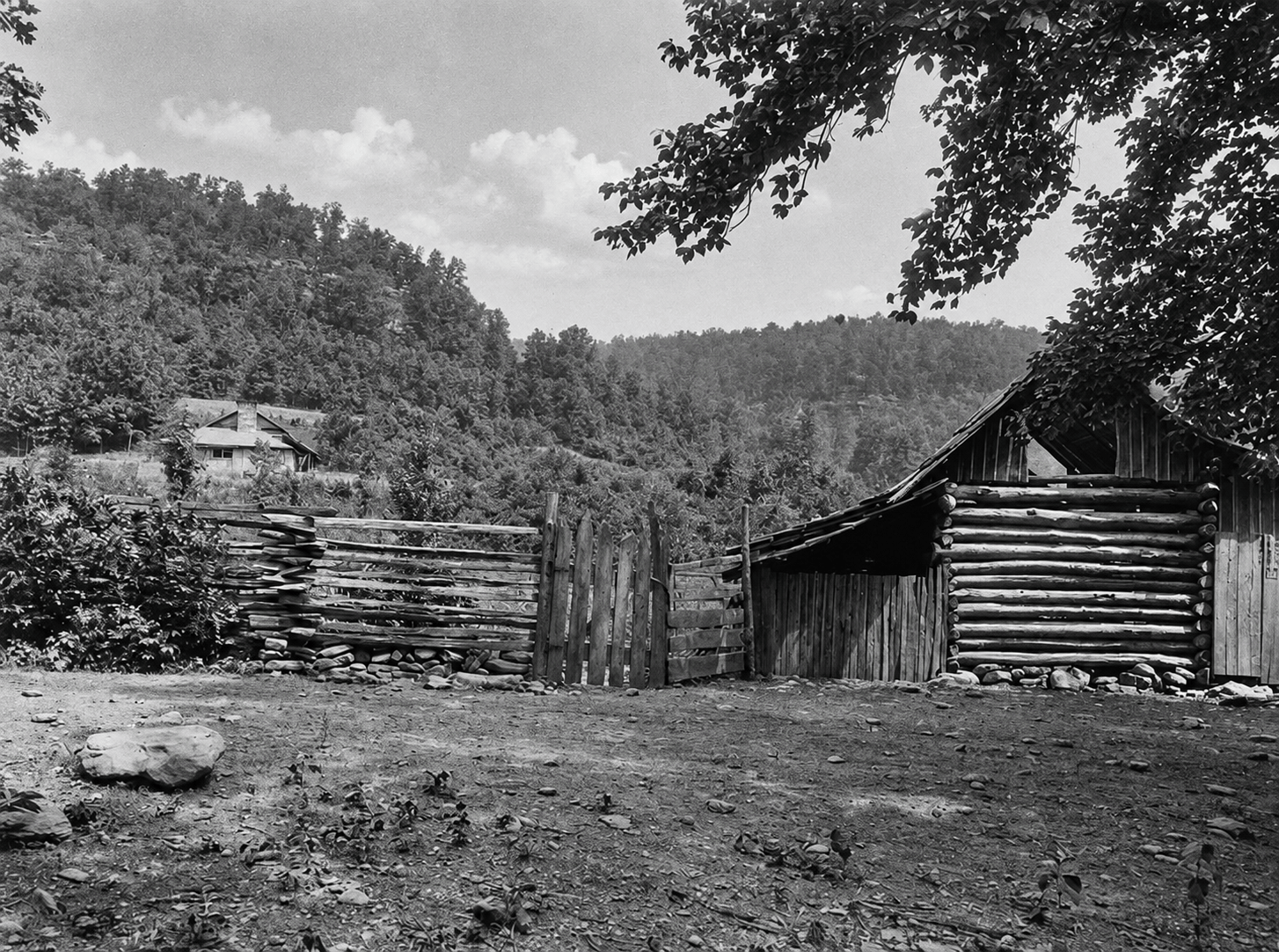
A hill farmer might have possessed very little money but still owned a house, several acres, chickens, hogs, a milk cow, a smokehouse full of preserved meat, a corn crib, a garden, and enough woodland to provide firewood.
That family might have been poor by nearly any statistical measure.
But it could eat.
This was an enormous advantage when the cash economy collapsed.
A family that owned its land outright and produced much of its own food could survive conditions that would devastate a family dependent upon wages or credit.
People butchered hogs, canned vegetables, gathered wild berries, hunted squirrels and rabbits, fished creeks, planted corn and beans, kept chickens and traded labor with neighbors.
Clothing was repaired rather than replaced.
Flour sacks became fabric.
Buildings were patched rather than rebuilt.
Tools were repaired until repairing them became almost an art form.
Nothing useful was casually discarded.
These practices were not invented by the Great Depression. They were already part of life in much of rural Arkansas.
That is one reason the Depression could sometimes appear less dramatic in isolated hill communities than in industrial cities.
A factory worker in Detroit who lost his job might suddenly lose nearly his entire means of support.
A subsistence farmer in Newton County who sold almost nothing and bought almost nothing might see considerably less immediate change.
His family had never depended heavily upon the stock market, a large salary, or the urban consumer economy.
But that should not be confused with prosperity.
The fact that a family could survive poverty did not make poverty comfortable.
 Even Self-Sufficient Families Needed Money

There were limits to self-sufficiency.
Taxes required money.
So did shoes, medicine, coffee, sugar, salt, kerosene, farm machinery, ammunition, school supplies, and dozens of other things that could not easily be produced at home.
Property taxes could be particularly dangerous.
A family might own its farm free of a mortgage and still lose the land because it could not produce enough cash to pay taxes.
Medical emergencies could become financial catastrophes.
A worn-out mule could threaten an entire year’s farming.
A failed crop could empty both the pantry and the small amount of money a family expected to earn.
And plenty of crops failed.
The drought of 1930–31 struck Arkansas with extraordinary severity. Gardens burned up. Corn withered. Pastures disappeared. Livestock suffered.
 To relieve the urgent food needs in isolated mountain communities, the Red Cross took up truckloads of cornmeal, flour, beans, lard, syrup, coffee, etc. The little farms these folks owned failed them completely because of the drought.
For a family whose main defense against the Depression was growing food, drought attacked that defense.
The disaster exposed just how close many rural Arkansas families had already been living to the edge.
The Timber Economy Collapsed Too
Agriculture was only part of the hill-country economy.
Timber had transformed much of upland Arkansas beginning in the late nineteenth century. Logging crews, sawmills, railroads, and company towns brought cash employment into areas where opportunities had previously been limited.
By the 1920s, thousands of hill-country families depended directly or indirectly upon timber.
Then that economy contracted.
Arkansas’s large-scale timber boom had already passed its peak, and lumber prices began a steep decline in the late 1920s. Construction slowed nationally, demand weakened, and many smaller lumber operations closed or consolidated.
Hundreds of workers in the Arkansas hill country lost their jobs.
For a subsistence farmer, falling stock prices on Wall Street might mean very little.
For a sawmill worker whose weekly paycheck disappeared, the Depression was immediate and unmistakable.
The same was true for people dependent upon railroad work, mining, small manufacturing, stores, or other cash employment.
How much a family participated in the cash economy often determined how violently the Depression struck it.
The Depression Could Be Almost Invisible—and Still Everywhere
This produced one of the paradoxes of rural Arkansas during the 1930s.
A visitor might pass a mountain cabin and see chickens scratching in the yard, smoke rising from the chimney, corn stored for winter and children playing outside.
Life appeared to continue.
And in a sense, it did.
 Women and children outside a house in Arkansas, 1931
There might be no foreclosure notice nailed to the door. No breadline stretched down the road. No shuttered automobile factory dominated the landscape.
But look more closely.
The family’s clothes might be patched again and again.
The children might have one pair of shoes each.
Dental problems went untreated.
A trip to a doctor might be postponed indefinitely.
The roof leaked.
The farm equipment was decades old.
A child who wanted more education might have no practical way to obtain it.
Young adults often faced a choice between staying in a place with few opportunities or leaving home.
The Depression was not always a sudden descent from prosperity into poverty.
For thousands of Arkansas hill people, it tightened an already tight existence.
Small Towns Felt It Differently
The Depression was often more visible in the towns.
 Merchants depended upon rural customers. Banks depended upon borrowers being able to repay loans. Professionals depended upon clients having money.
As farm income declined, the entire local economy contracted.
Banks failed throughout Arkansas during the early Depression years. Between 1930 and 1940, the number of banks operating in the state dropped dramatically.
Savings accumulated over decades could disappear.
Credit dried up.
Businesses closed.
Teachers were sometimes paid in warrants that could not immediately be converted into their full cash value. School terms were shortened. Road work and other public improvements suffered because tax revenues disappeared.
The consequences worked their way outward until even families who produced most of their own food encountered the Depression through failing institutions around them.
Roosevelt’s New Deal Reached Into the Hills
After Franklin D. Roosevelt became president in 1933, the federal government entered rural life on a scale Americans had never previously experienced.
The Civilian Conservation Corps became particularly important in Arkansas.
Young men received food, housing, work, and modest wages while building roads, trails, bridges, fire towers, parks, and other public improvements.
They sent much of their pay home.
That small stream of reliable cash could be extremely important to a struggling family.
The Works Progress Administration provided employment on roads, schools, and public buildings. Other federal programs attempted to stabilize agriculture, provide relief, improve rural life, and conserve badly damaged land.
Not every program worked equally well.
Some agricultural programs benefited landowners more than tenants. Reducing crop acreage sometimes meant fewer workers were needed. Across Arkansas, federal agricultural policies could actually contribute to the displacement of tenant farmers.
Yet in the hill country, New Deal programs also left an extraordinary physical legacy.
Roads were improved.
Parks were developed.
Forests were restored.
Public buildings appeared.
Young men acquired skills.
Families that rarely encountered the federal government suddenly received paychecks carrying its name.
Electricity Was Still Somewhere in the Future
The modern world was approaching rural Arkansas, but very unevenly.
By the 1930s, automobiles and radios had changed communication and travel, but many hill-country families still lived without electricity.
Water came from wells or springs.
Wood heated houses.
Families preserved food by smoking, salting, drying, and canning.
Work that electricity would later perform with the flip of a switch still required human or animal labor.
Rural electrification accelerated after the Rural Electrification Administration was created in 1935, but bringing electrical lines through sparsely populated hill country took years.
For many Arkansas families, the dramatic technological transformation of rural life occurred more in the 1940s and 1950s than during the supposedly modern 1920s.
Some People Were Less Affected Because They Had Less to Lose
There is a temptation to romanticize this.
We should resist it.
An Ozark family’s ability to survive without much money shows extraordinary resourcefulness, but it also tells us how little that family had in the first place.
A farmer who never owned stocks did not lose money in the stock market crash.
A household without electricity did not worry about paying an electric bill.
A family that raised its own food was less vulnerable to unemployment than a wage-earning household.
But these were hardly signs of economic security in the modern sense.
They were signs of a society in which people still lived partly outside the modern cash economy.
That isolation could protect them when the national economy collapsed.
It could also trap them in poverty.
Both things could be true at once.
The Depression Did Not Create Arkansas Hill-Country Poverty
Perhaps the greatest misunderstanding about the period is the assumption that the Great Depression created rural poverty.
It did not.
 Much of the hill country had known poverty for generations.
The Depression exposed it, intensified it, and sometimes destroyed the fragile economic arrangements that allowed families to survive.
A household that owned productive land, carried little debt, had livestock and possessed enough family labor might endure the 1930s remarkably well.
Its members would work hard and possess little cash, but they could survive.
A neighboring family might rent its farm, depend upon timber wages, or carry a mortgage.
Its experience could be entirely different.
One missed payment might become another.
A job disappeared.
A bank failed.
A mule died.
A crop burned up.
Soon the family was gone.
That is why no single Arkansas Great Depression story exists.
Hard Times Were Relative
Years later, Americans who had grown up in the Arkansas hills sometimes recalled the Depression in ways that surprised younger generations.
Some remembered terrible deprivation.
Some remembered neighbors helping neighbors.
Some remembered government work programs saving their families.
And some famously remembered something close to this:
We were poor before the Depression, poor during the Depression, and poor afterward. We didn’t know there was a Depression.
The wording varies because people have repeated versions of that observation throughout rural America.
But the sentiment contains an important historical truth.
The Great Depression was catastrophic.
Yet catastrophe is measured partly by what existed before it.
For millions of Americans accustomed to wages, banks, mortgages and consumer goods, 1929 represented a shocking collapse of normal life.
For many people in Arkansas’s hill country, normal life was already hard.
They had lived for years with marginal farms, unreliable income, isolation, primitive roads, and very little money.
 The 1930s brought drought, unemployment, collapsing markets, and unprecedented economic distress.
But in some cabins scattered through the Ozarks and Ouachitas, breakfast was still biscuits, gravy and eggs from the same chickens scratching in the same yard.
The mule still had to be harnessed.
Wood still had to be cut.
Corn still had to be planted.
The cow still had to be milked.
And tomorrow’s supper still depended much more on what a family could raise, hunt, preserve, or barter than on what happened on Wall Street.
The Depression changed Arkansas profoundly.
But for some people living in its hill country, the most remarkable thing about the hard years of the 1930s may have been how much of their already difficult life stayed exactly the same.


