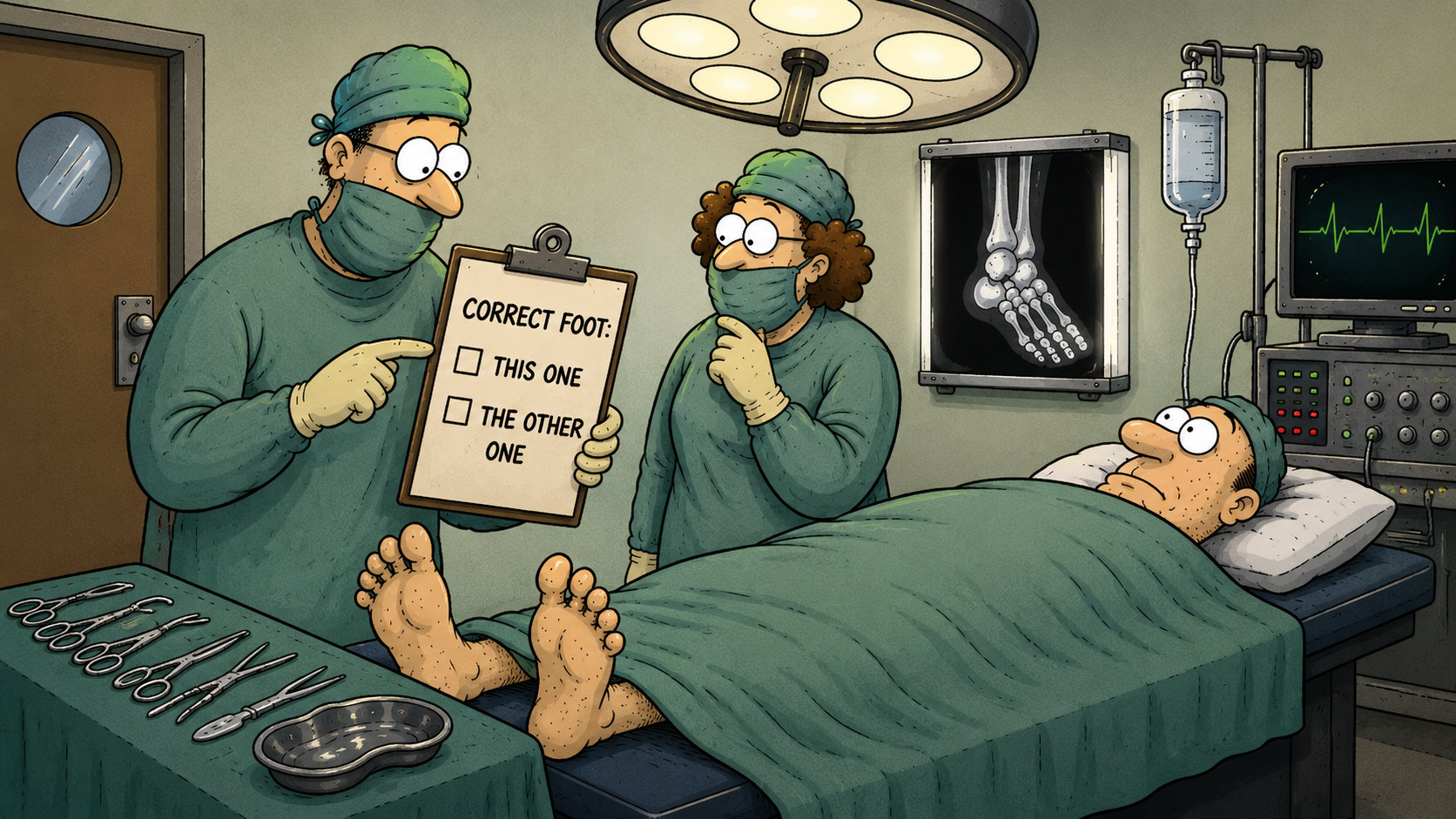
 Most people have heard the horror stories: a surgeon operates on the wrong leg, the wrong arm, or even the wrong patient. They sound like urban legends, but they aren’t. These mistakes have happened.
The good news is that they’re rare, and they’re much rarer today than they used to be.
That’s because medicine learned an important lesson. Good surgeons aren’t enough. Good systems matter just as much.
Today, before an operation begins, the patient’s identity is checked repeatedly. The procedure is confirmed. The correct surgical site is usually marked while the patient is still awake. Then, just before the first incision, the entire operating room pauses for what’s called a “time out.” Everyone in the room confirms they’re about to perform the right procedure on the right patient and the right body part.
It may seem repetitive. It’s supposed to be.
The checklist isn’t there because anyone expects the surgeon to forget which knee to operate on. It’s there because human beings make mistakes, especially in busy, stressful environments. Aviation learned that decades ago. Medicine followed.
That’s why cartoons about “wrong-side surgery” resonate. They exaggerate the absurdity of confusion at exactly the moment when there shouldn’t be any. We laugh because the situation is ridiculous—and because we know the consequences wouldn’t be.
Most safety rules exist because someone, somewhere, learned a painful lesson the hard way. Wrong-site surgery is one of them.
Sometimes the most important words spoken in an operating room aren’t the technical ones.
They’re the simple ones:
“Let’s make absolutely sure we have the right patient, the right procedure, and the right side.”
Odds & Ends 018


