Old photographs rarely give up their details easily.
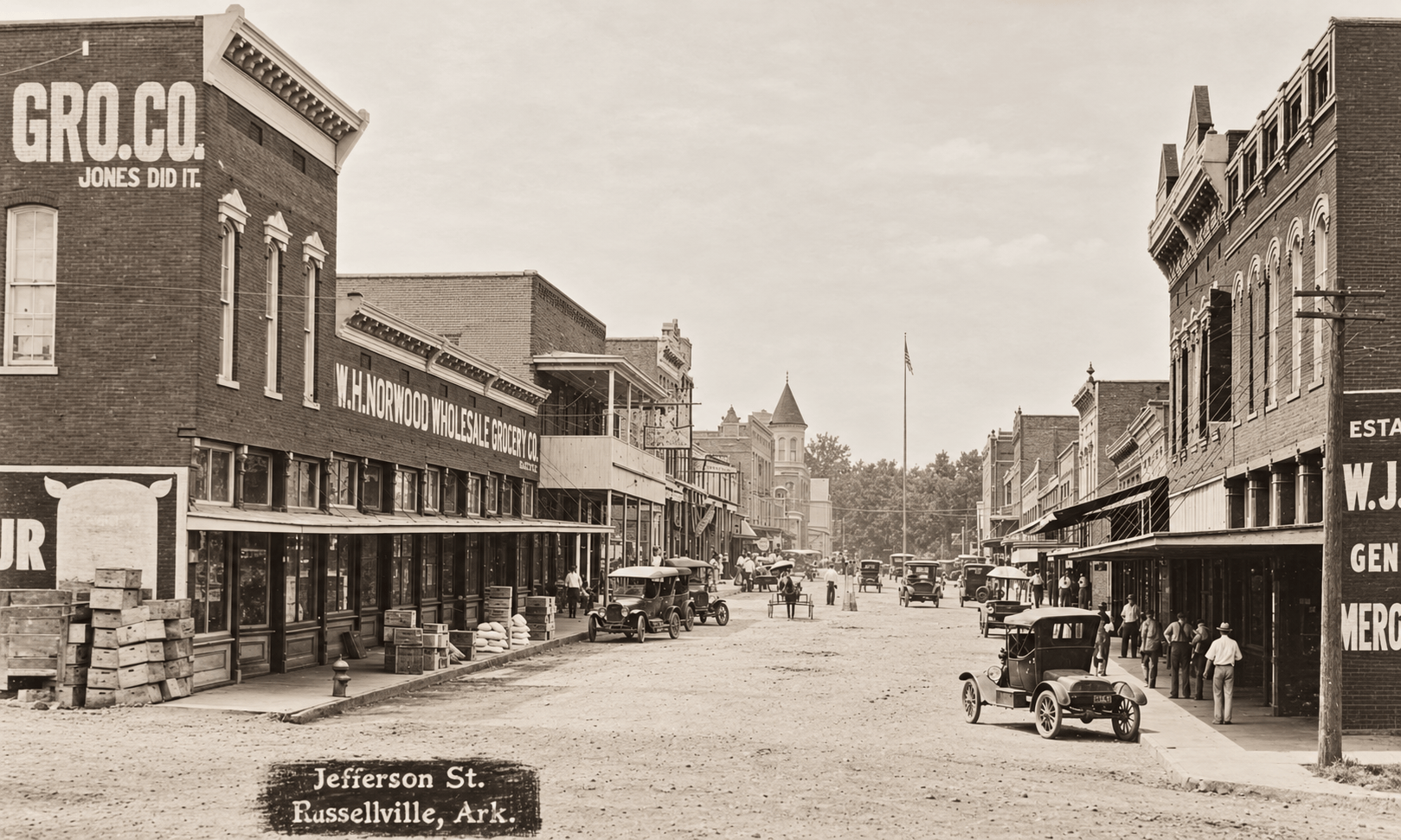
The image I started with was a badly damaged street scene (below) identified as Jefferson Street, Russellville, Arkansas. It had most of the common problems of photographs that have survived for more than a century: tears, stains, creases, fading, missing emulsion, and a large damaged area across the sky and upper center of the picture.
 But beneath it all was a remarkable view of downtown Russellville and what is today Commerce Avenue.
The goal was not to create a prettier version of Russellville. It was to recover as much of the original photograph as possible.
That distinction matters.
AI image tools are very good at creating something that looks historically believable. They are much less reliable when the job is to re-create the exact details of a particular historic photograph. If part of a building is damaged, the software tends to “help” by inventing what it thinks ought to be there. The same thing happens with automobiles, windows, signs, people, rooflines, and especially lettering.
So I gave re-creation instructions much more specific than “fix all the damage”:
Remove the tears.
Remove the stains.
Repair the damaged sky.
Recover the contrast.
Preserve the buildings, vehicles, people, signs, and proportions.
And, most importantly: don’t invent anything that isn’t supported by the photograph.
That last instruction is easier to write than it is to enforce.
The first version was impressive at a glance. The street suddenly had depth again. Brickwork emerged. Automobiles became recognizable. Storefronts buried under damage looked almost new. The large tear through the upper portion of the photograph disappeared.
But then came the part that matters in historical work: looking closely.
The re-creation had created a wonderfully crisp sign on the large building on the left.
Unfortunately, it said:
“THANORWOOD WHOLESALE GROCERS.”
That was not what the sign said.
The original photograph was damaged and hard to read, and the AI did exactly what AI tends to do with uncertain text. It produced something that looked convincing enough to pass at first glance.
Convincing is not the same thing as correct.
The business was W. H. Norwood Wholesale Grocery Co.
Once that was established, I went back to the re-created image and made another pass with a much narrower instruction: change only the sign on that building. Leave the rest of the re-creation alone.
The corrected version now reads:
H. Norwood Wholesale Grocery Co.
That little correction illustrates the entire problem with re-creating historical photographs using modern image tools.
The technology is extraordinary. It can remove a century of physical damage in seconds. It can reconstruct missing sky, strengthen fading architectural details, clarify automobiles and pedestrians, and recover the visual depth of a scene that had nearly disappeared.
But you cannot treat it as an authority.
The original photograph remains the authority.
The re-creation is an interpretation of that evidence.
In some ways, the process is not very different from other historical research. You start with incomplete evidence. You make the best reconstruction you can. Then you compare the result with what you actually know. When something does not fit, you correct it.
Sometimes the mistake sits there in six-inch-high letters.
What finally emerged is not a newly imagined Russellville street scene. It is an attempt to recover the photograph that was already there: Jefferson Street lined with commercial buildings, early automobiles in the roadway, people gathered beneath the awnings, and W. H. Norwood Wholesale Grocery Co. occupying a prominent place on the block.
I would still never use the re-created image as evidence for a detail that cannot be confirmed elsewhere.
But as a way of seeing the old photograph again?
That is where this technology becomes fascinating.
For a moment, the tears, stains, and missing emulsion are gone, and Jefferson Street looks a little more like it did when someone stood in the road, pointed a camera down the block, and made the original photograph.
Further developments
Rita Goodman identified that the flagpole was missing from the re-created image. It stood at the junction of Main Street and Jefferson Avenue.
John Paul Leonard, Jr. (Beatnik Angel) shared a version of the postcard that shifted to the left. It shows more of the building on the left and less of that on the right. He asked whether we could incorporate that into the image.
Below is a re-creation that incorporates the flagpole and the added material on the left.
Odds & Ends 038


