20 Copyright Facts

Here are a few copyright law “facts.”

  1. All U.S. works PUBLISHED before 1923 are in the public domain.
  2. Copyright experts estimate that 85% of all U.S. works published between 1923 and 1963 are now in the public domain.
  3. All facts and ideas are in the public domain.
  4. There are no official “copyright cops.” However, there are many self-appointed ones who fuss about sharing of materials.
  5. Material published before 3/1/89 without a valid copyright notice is in the public domain. (There are some exceptions to this, but they are few and far between.)
  6. A compilation of facts is protected by copyright only to the extent that the selection of the material and the arrangement of the material is ORIGINAL. (A compilation of ALL of the headstone inscriptions for a cemetery does not meet the originality requirement for selection of material.)

more at Copy Right, Copy Sense


Post from one of my abandoned blogs – North Farnham Freeholder – recovered from Internet Archive WayBackMachine 2/28/2011 – page


0 comments
None

Splogs!

Give me a break!

This should be upsetting to anyone who has a real blog!

In the past, I have not spent a lot of time looking at other blogs. Blogging, for me, has been a way to publish valuable content on line on a regular basis. For example, Chronicles of the American Civil War currently has 3,972 posts, most of them in 2005. That’s somewhere between 5 and 10 posts every day for over a year. Granted, the posts to Chronicles are mostly articles and other materials that were written during the civil war, but it’s been a lot of effort to process, edit, and then post all of them to the blog.

Besides Chronicles , I have 3 other blogs where, like this one, I generally publish material of some kind each day.

This blog, North Farnham Freeholder, has been established for quite some time, but for a long time it lanquished with no content while I worked at other things like Chronicles . In the last few weeks, I’ve been resurrecting it and trying to make sure that I was able to find some little bit to publish each day. (I ended up deleting the datbase completely and starting fresh, but that’s another story.) Unlike the others, which have specific focuses for their content, my intent with this one is for it to be a “little bit of this… and a little bit of that,” just whatever I happen to stumble across and/or decide to add or comment on.

Well, today I was looking for some blogs related to camping and RVs — and I started running across all of these blogs filled with ads and little or no content. Whats the deal with these….? So I started doing a lttle more looking and then remembered something that I had read a few days ago on Performancing.com in an article called Exclusive: Google Teaches Bloggers How To Rank, a blog “interview with senior Google engineer Matt Cutts. One of the questions and its answer deals with Blogger’s “splogs” problem. Ahah!

According to Wikipedia,

Spam blogs, sometimes referred to by the neologism splogs, are weblog sites which the author uses only for promoting affiliated websites. The purpose is to increase the PageRank of the affiliated sites, get ad impressions from visitors, and/or use the blog as a link outlet to get new sites indexed. Content is often nonsense or text stolen from other websites with an unusually high number of links to sites associated with the splog creator which are often disreputable or otherwise useless websites.

Spam blogs — why am I not surprised?

I’ll say it again. This should be upsetting to anyone who has a real blog! — at least to those who are interested in having others find their blog and visit it.

Again from Wikipedia:

Splogs have become a major problem on free blog hosts such as Google’s Blogspot service. These fake blogs waste valuable disk space and bandwidth as well as polluting search engine results, ruining blog search engines and damaging bloggers community networking (e.g. Blogspot’s next blog link). Google’s search engine uses PageRank, which is very vulnerable to link flooding, especially from highly weighted bloggers.”

Like spam and phishing, splogs, as far I’m concerned, are created for the most part by unethical people who are only interested in making money without making any contribution.

Today’s links:


Post from one of my abandoned blogs – North Farnham Freeholder – recovered from Internet Archive WayBackMachine 2/28/2011 – page


0 comments
None

A ferry

image

This photograph is of a unique ferry is in Mammoth Caves National Park in Kentucky. We made a side trip to the park on our way home from Springfield, Massachusetts in July 2004. The ferry ride isn’t very long and, obviously, it can’t accommodate many vehicles.


Post from one of my abandoned blogs – North Farnham Freeholder – recovered from Internet Archive WayBackMachine 2/27/2011 – page


0 comments
None

Poker

Don’t get me wrong, I understand how to play poker — and several of the variations.

What I don’t understand is it’s popularity. It’s not like it’s something new. I was playing poker over a quarter of a century ago — and quit when it put my young family in financial difficulty.

It was in the 1970s—cold war time period—and I was on a missile submarine in the North Atlantic. It was a three month patrol, 90 days without any way for the individual sailor to communicate with anyone not on the ship. We could receive five family grams during the patrol — 20 words, and censored to ensure there was nothing upsetting.

There wasn’t a lot of entertainment available to us for distraction. We didn’t have video games, DVDs or even VCRs. We had movies after the evening meal, but if you were on watch or asleep you didn’t get that. Most guys brought some books and there was a tiny library with a few more.

A lot of the time, for some, was filled with games, mostly card games like pinochle, spades, hearts, and cribbage. Some guys played backgammon. And then there was the weekly poker game and — in the middle of patrol — casino night. I’m not sure what the legality of it was, but as an enlisted man, I have sat next to the commanding officer of the ship at a black-jack table while at 400 feet below the surface of the ocean — and, yes, we were gambling for money. A percentage went to the “welfare and rec. committee.” Funds from it, I suppose were available to help guys and their families who might, at times, be struggling to make ends meet. The only benefit personally I saw from it was the ships party held each year when we were the crew off of the ship. (The missile subs had two crews — the blue crew and the gold crew. I was on the blue crew.) As I recall it, there was only one casino night each patrol, and I always came out ahead from it.

The weekly poker night, though, is what brought me down. It wasn’t high stakes, but over a period of the several weeks, one could lose quite a bit of money. A percentage of the proceeds from it also went to the “welfare and rec.” fund. Since most of the guys didn’t have much money with them, the winnings and the losses were kept track of in a notebook. I never really did terribly bad, but I seldom came out a winner — and, for a time, I couldn’t stay away. When what I owed was somewhere over $200, I stopped. It wasn’t more that we would be able to handle. However, I still had to tell my wife that we were going to have to get by with less money for a while and that I had lost it by playing poker.

I never played poker after that. I really enjoyed playing the game, by I also recognized in myself that it was something that I could enjoy too much, that I could easily get very engaged in it and lose a lot more than I lost on that submarine and that I lost that when there wasn’t a drop of alcohol to be had anywhere. I hate to think how much I would have lost if American ships allowed liquor on board.

Don’t get me wrong. I’m not against gambling. I gamble on occasion, generally the slots — and the lottery, when I get somewhere that has one —, but I don’t let my enjoyment of it overwhelm me, like I know it could. I keep in mind that I’m not going to win big and that I will likely take home less money than I came with, but I won’t lose more money than I planned.

Some card related links:
Rules of Card Games – Alphabetical Index
Poker.com
Card game – Wikipedia, the free encyclopedia
Poker- the free encyclopedia


Post from one of my abandoned blogs – North Farnham Freeholder – recovered from Internet Archive WayBackMachine and edited slightly 2/27/2011 – page


0 comments
None

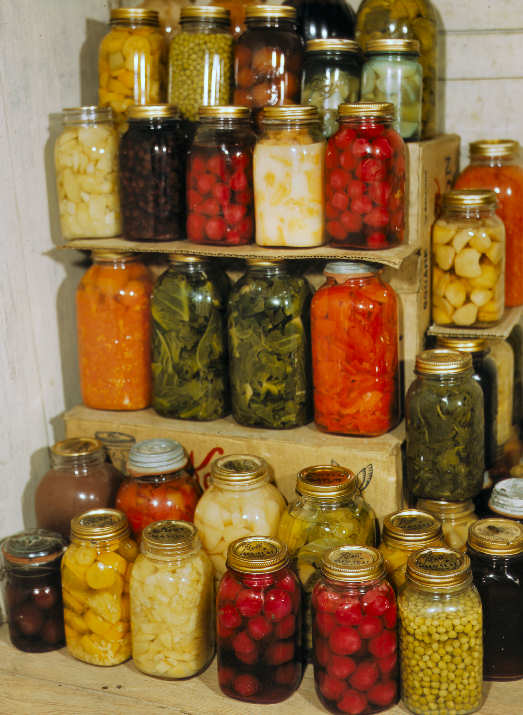
Stacks of home-canned food

image

Photographer: unidentified
Original color slide image created: 1941 – 1945
Lib. of Congress—Farm Security Administration – Office of War Information Collection

This photograph cropped and digitally enhanced, 11/26/2005 © MpG
Public domain digital file from original photographic image available at loc.gov


Post from one of my abandoned blogs – Images from the Public Domain – recovered from Internet Archive WayBackMachine 2/27/2011 – page


0 comments
None

“We don’t have any Indian ancestors!”

Boho Native Mandala over Pale Blue Mountains - both images from Canva ProI’m a product of our country’s cultural “melting pot,” third generation American in descent from my Czech great-grandparents.

I am thirteen or fourteen generations removed from my English ancestors who settled in New Jersey, Massachusetts, Virginia, and Rhode Island in the 17th and 18th centuries. My ancestors came from Ireland, Germany, France and probably other parts of Europe, many from before the Revolutionary War and some from after.

However, according to my grandfather, we don’t have any Indian ancestors!

The question apparently came up more than once. One instance recounted by my stepmother has her telling my father, “I’m not going anywhere with no Mexican.” Dad had been working long days shirtless and hat-less in the summer heat. Like me, with long exposure to the sun, he tans very darkly . I had a similar response from a girl many years ago, except I think she said something like, “Ewww, you’re as dark as a Mexican,” somewhat disdainfully.

A few years after that, I asked my grandfather if we had any Indian ancestry on his side. According to him, we didn’t.

Later, after he died, I began researching our ancestry. While I didn’t have a lot to go on, through various databases and the internet, I learned more about my ancestry, including a dirty little secret that wasn’t so dirty and not so much a secret in other branches of our family.

It turns out, of course, that there is some amount of Indian ancestry in my grandfather’s ancestry. I’m sure that he knew it or at least had some suspicion.

It was his grandmother, according to others who knew her, who tried to lighten her skin to be more attractive to the young man she was interested in, who tried to “pass” for white.

Whether or not I have Native American ancestry is not important, just interesting. It does not change who I am.

It does, however, change my views, though only slightly. I can accept that I have ancestry that some view as less than equal.

The thing that really interests me, though, is that very few people really know their ancestry. It is likely that there are many in America with ancestors who may have decided to “pass,” possibly including some who today have very narrow and bigoted views.


February 27, 2011 – Recovered post from one of my abandoned blogs – North Farnham Freeholder – from Internet Archive WayBackMachine and edited  page

June 20, 2019 – edited and added headline image.


0 comments
None

Frost (REDIRECTED)

Fire and Ice
Robert Frost

Some say the world will end in fire;
Some say in ice.
From what I’ve tasted of desire
I hold with those who favor fire.
But if it had to perish twice,
I think I know enough of hate
To know that for destruction ice
Is also great
And would suffice.


Post from one of my abandoned blogs – North Farnham Freeholder – recovered from Internet Archive WayBackMachine 2/26/2011 – page


0 comments
None

A Selection of Poetry (REDIRECTED)

Sonnet 18
William Shakespeare

Shall I compare thee to a summer’s day?
Thou art more lovely and more temperate:
Rough winds do shake the darling buds of May,
And summer’s lease hath all too short a date:
Sometime too hot the eye of heaven shines,
And often is his gold complexion dimm’d;
And every fair from fair sometime declines,
By chance or nature’s changing course untrimm’d;
But thy eternal summer shall not fade
Nor lose possession of that fair thou owest;
Nor shall Death brag thou wander’st in his shade,
When in eternal lines to time thou growest:
So long as men can breathe or eyes can see,
So long lives this and this gives life to thee


Post from one of my abandoned blogs – North Farnham Freeholder – recovered from Internet Archive WayBackMachine 2/26/2011

6/13/19 – redirected to new post on A Selection of Poetry

0 comments
None

Probabilities, Voting and Nader

Ralp Nader, Library of Congress photoThere are a lot of probabilities associated with voting. Unfortunately, some folks confuse polls with the probability of a candidate being elected.

For instance, let’s say that a national poll says that George Bush is favored by 48% of the popular vote, John Kerry 48%, and Ralph Nader 4%.

Some would say that, from the results of this poll, the probability of election to the presidential office is 48% each for Bush and Kerry and 4% for Nader. But that’s just flat wrong!

At best the poll predicts a even probability, 50% to 50%, for Bush and Kerry.

The probability of Nader being elected is 0%.

Even if all of the national polls being done were showing Nader with 10 to 15%, the probability of his being elected would still be 0%.

A vote for Nader is a wasted vote, because he is not going to win under any conceivable set of circumstances.

Some might say, “No, it’s not wasted. It’s a protest vote, because neither of the two main candidates are worthy of my vote.”

Nobody will remember the protest votes when the presidential term begins on January 20, 2005. Protest votes are meaningless, worthless, and wasted. They do not make a difference!

Please don’t waste your vote on a zero probability!


February 26, 2011 – Retrieved post from abandoned blog – North Farnham Freeholder – recovered from Internet Archive WayBackMachine – page

June 12, 2019 – Minor edits; added picture of Ralph Nader: Source image from Library of Congress: “Rights Advisory: No known restrictions on publication.”


0 comments
None

I finally watched “Fahrenheit 9/11”

I didn’t see the film1 when it was in the movies. I had no need to see it then as I had already decided who I was going to vote for. There was no way that the film was going to change my mind.1

After it came out on video, I went to the local video-music-book store specifically to see if there was any copies available. They must have had a hundred – and they were all rented out. That was last weekend.

This weekend, I went in early, before the local Friday evening “rush hour.” A few copies were available.

I watched it this evening.

Michael Moore definitely has an agenda – and so does the film. However, there is plenty in the film that stands powerfully alone, independent of any agenda.

I thought to write here about the movie, but that’s been done over and over again by others so I’m not going to.

However, I would like to issue a challenge to anyone who has not seen it.

Watch the film.

That’s all that I ask. Nothing more.

For those who read this, please do not misunderstand me. I voted for Gore because I mistrusted Bush. When the world voted to hold Saddam Hussein accountable, I agreed. I felt that our government wrong to attack without the backing of the United Nations Security Council or most of our traditional allies. However, once it was obvious that we were past the point of no return, I fully supported our military personnel and their military leaders. I believed that Saddam was a legitimate threat and that he probably had weapons of mass destruction. Even after none had been found, I held out hope that they would be. I hoped that my mistrust of Bush would be proven to be unfounded – I have long since given up on that hope.


1. Fahrenheit 9/11 – Wikipedia (accessed June 11, 2019)

Fahrenheit 9/11 is a 2004 American documentary film directed, written by, and starring filmmaker, director and political commentator Michael Moore. The film takes a critical look at the presidency of George W. Bush, the war in Iraq, and its coverage in the media. In the film, Moore contends that American corporate media were “cheerleaders” for the 2003 invasion of Iraq, and did not provide an accurate or objective analysis of the rationale for the war and the resulting casualties there.

The film generated intense controversy, including disputes over its accuracy. The title of the film alludes to Ray Bradbury’s 1953 novel Fahrenheit 451, a dystopian view of the future United States, drawing an analogy between the autoignition temperature of paper and the date of the September 11 attacks; one of the film’s taglines was “The Temperature at Which Freedom Burns”.


February 26, 2011 –– Post from one of my abandoned blogs – North Farnham Freeholder – recovered from Internet Archive WayBackMachine – page

June 11, 2019 – Minor revision; added footnote with Wikipedia description of the film.


0 comments
None