from Eyes of the Great Depression 048 – to be published October 1, 2010

Previously:

from Eyes of the Great Depression 048 – to be published October 1, 2010
Previously:
These critters were on the trail above Hidden Falls and past Inspiration Point, Grand Teton National Park, Wyoming, July 18, 2010.


from Eyes of the Great Depression 048 – to be published October 1, 2010

I check the status of solar activity and sunspots regularly – usually once a day, just a quick check, along with several other things I’m interested in.
I’ve also had a few related blog posts:
The sun isn’t as completely spotless as it was a year ago, but spotless days are still occurring – and, according to a new study discussed in Science, sunspots may soon disappear for decades.

Scientists studying sunspots for the past 2 decades have concluded that the magnetic field that triggers their formation has been steadily declining. If the current trend continues, by 2016 the sun’s face may become spotless and remain that way for decades—a phenomenon that in the 17th century coincided with a prolonged period of cooling on Earth. (Say Goodbye to Sunspots? by Phil Beradelli, September 14, 2010, ScienceNOW)

The study is also discussed in a Financial Post article by Lawrence Solomon:
We are now in the onset of that next sunspot cycle, called Cycle 24 – these cycles typically last 11 years — and Livingston and Penn have this month published new, potentially ominous findings in a paper entitled Long-term Evolution of Sunspot Magnetic Fields: “we are now seeing far fewer sunspots than we saw in the preceding cycle; solar Cycle 24 is producing an anomalously low number of dark spots and pores,” they report.
Their conclusions have potential “dramatic implications.” Cycle 24 could have just half the number of sunspots as the recently completed Cycle 23, and there could be “virtually no sunspots in Cycle 25.” The implications of their research points to decades of spotlessness. (Chilling Evidence, by Lawrence Solomon, September 16, 2010, Finanacial Post)
If this study proves out – and it is consistent with other studies and indicators – we are likely faced with declining global temperatures rather than global warming.
And that would not be good – far more people suffer and die as a result of cold than of heat. Extended periods of cold would have an adverse affect on crops. Frigid winters and cold summers during the Dalton Minimum, which lasted from about 1790 to 1830, resulted in massive crop failures, famine and death. The Maunder Minimum, also known as the Little Ice Age, lasted for about 70 years, from about 1645 to 1715, and “was marked by bitter cold, widespread crop failures, and severe human privation.”¹ The Dalton and Maunder Minimum were periods of low solar activity and low sunspot count.
The sun has not fully escaped the solar minimum between solar cycles 23 and 24. A typical solar minimum will see 486 days without sunspots. Since 2004, there has been 809 blank days, 41 so far in 2010, and the most recent just in the past week. If scientists were to use the telescopes of the Dalton or Maunder Minimum, the number of blank days would likely be quite a bit higher and many of the recent sunspots would not have been counted.

Of course, some may say that for long term forecasting, one would have just as much fortune depending upon the Old Farmer’s Almanac. Ironically, though, sunspots are taken into consideration in the Old Farmer’s Almanac forecasts.
We employ three scientific disciplines to make our long-range predictions: solar science, the study of sunspots and other solar activity; climatology, the study of prevailing weather patterns; and meteorology, the study of the atmosphere. We predict weather trends and events by comparing solar patterns and historical weather conditions with current solar activity.
¹ from a 2008 Livingston and Penn paper
On July 18, we took a boat ride across Jenny Lake and hiked up past Hidden Falls and Inspiration Point into Cascade Canyon.
This little video was shot using my smart phone.
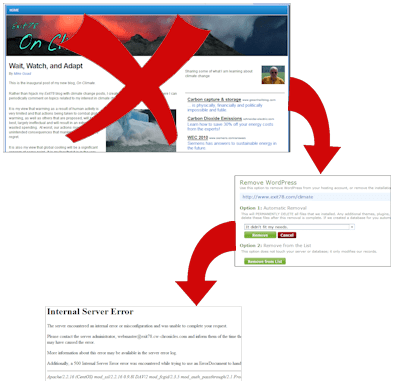
No, not this one.
Exit78 is still here and I have no plans for it to disappear anytime soon.
However, after reading a post by Lorelle VanFossen, Blog Struggles: I Need an Eraser for My Old Posts, relating to redoing old posts, I got to thinking that there were a couple of old blogs that I need to redo erase.
Early last year, I created a blog about climate change called “On Climate.” While I put a lot of effort into it and had lots of links to lots of resources, in the end, I really didn’t have that many posts – and I hadn’t posted to it for over a year. There are just too many other blogs on the subject by talented and knowledgeable people and I just didn’t want to spend the time with it that it would take to be any more meaningful than a drip in a bucket.
So I decided that”On Climate” was the first blog that was going to go.
I didn’t toss the content, though. All but one of the posts and all of the reference pages were converted into posts on this blog, each with it’s original date and time, or real darn close.
I also moved all of the comments over – all ten or twenty of them, complete with URL links and comment luv links.
Since these were all old posts, I didn’t even want to think about trying to redirect from the old location to the new. Besides, in taking the blog down, I also destroyed the database. 😉
Have you ever “destroyed” a blog, intentionally or otherwise?

 I still had the folder open with the images from our 2001 visit to New York City – the folder with the image I used to create Remember – so, on impulse, I created an photo stack montage, with an image of the World Trade Center on top of the “stack.”
According to a report on abc15.com, Arizona weighs privatization for state parks, operation of a couple of Arizona may be turned over to private operators

Arizona officials might turn over management of two small state parks to private operators so they can reopen the sites that were closed because of budget trouble.
The 28-park state system already uses concessionaires to provide some services but now may go further by turning to the private sector for the actual operation.
The parks system has requested proposals due Sept. 23 for operation of Oracle State Park in southeastern Pinal County and is considering whether to issue a request for proposal for Lyman Lake in southern Apache County.
See abc15.com, Arizona weighs privatization for state parks, for more.

Photo was manipulated in Paint Shop Pro from a photo I took on the boat to Ellis Island during our one and only trip into New York City, about 2 months before 9-11-2001.