
Satellite bulls sparring during elk rut season,
Moraine Park, Rocky Mountain National Park, September 1, 2009
Our 2009 visit to Rocky Mountain National Park was specifically timed to coincide with the annual elk rut season. It was the second time we had been there when the elk herds were gathering in Moraine Park. The previous time was near the end of a four week vacation when we stayed at the Stanley Hotel in Estes Park.
The elk rut takes place between the middle of August and the middle of October, depending on the climate in which they live. During the rut elk frequently use areas around fresh water, and tend to bed in heavy timber five to six hours per day.
Younger, smaller bulls are known as satellite bulls, as they tend to cling to the edges of a herd trying to pick up any cows willing to leave the herd.
Satellite bulls frequently spar with one another during the rut, and in turn make sparring squeaks. A bugle is a vocalization made exclusively by bulls. A bugle can be directed toward other bulls or toward cows. A bull will direct his bugle toward his cows while gathering them or while chasing an estrus cow. A herd bull will direct his bugle toward another bull to express his dominance over the herd, while a satellite bull may use his bugle to challenge the herd bull. (Wikipedia)

Hollyhocks, Gilcrease Museum grounds, Tulsa, Oklahoma, June 25, 2013
Two years ago, we left the motorhome behind and took a short road-trip over to Tulsa, Oklahoma for a few days. One stop we had planned was Gilcrease Museum. We had visited years before and wanted to see it again.
Gilcrease Museum is a museum located northwest of downtown Tulsa, Oklahoma. The museum houses the world’s largest, most comprehensive collection of art of the American West, as well as a growing collection of art and artifacts from Central and South America. The museum is named for Thomas Gilcrease, an oil man and avid art collector. (Wikipedia)
Museum website
There were two things that were disappointing about the Gilcrease Museum visit. It was hot when we went out exploring the grounds, not surprising for summer in Oklahoma, and photography is not allowed inside the museum.

Cooling Towers at Three Mile Island, Unit 1, May 19, 2009 on Pa 441 looking NNW.
I’ve never actually been within the protected area fencing at Three Mile Island. The closest I came was a 2 day meeting at the training center about 10 to 15 years ago. The training center is about a mile on down the road from where this picture was taken, on the right.
The plant I worked at and was licensed to operate is the same type of plant as the two Three Mile Island Units.

Buffalo – Custer State Park, South Dakota, August 20, 2007
Smokey skies were to plague us much of our 2007 trip out west. It had been a hot dry summer for much of the nation and forest fires to the west of us – some all the way out in California – meant smoke in the air for our trip. We had deliberately delayed our trip, which was to take two months, to later in the season when the chance of fire was much lower. It was the first long trip after retirement. At this point in the trip, we had been away from home 8 days or so and we were planning to be gone until near the end of September.

Bear Lake, Rocky Mountain National Park, Colorado, September 3, 2009
The Bear Lake trail is an easy walk, about 1 mile to go all the way around. We’ve done this pleasant trail almost every time we’ve visited the park and have taken several of the trails that start from here.
Bear Lake is a scenic trailhead and destination in Rocky Mountain National Park. Sitting at an elevation of 9,450 feet (2,880 m), the alpine lake rests beneath the sheer flanks of Hallett Peak and the Continental Divide at 40.31324°N 105.648222°W. Several trails, from easy strolls to strenuous hikes, start from the lake. The Bear Lake Road is open year round, though it may temporarily close due to adverse weather conditions. An ample parking lot is provided close to the lake. The Bear Lake Road is approximately 10 miles long and starts close to the Beaver Meadows Entrance station of the Rocky Mountains National Park.
The lake was formed during the ice age by a glacier. Several moraines can be found downhill of Bear Lake. (Wikipedia)

Civil War era smooth bore field cannon,
Fort Smith National Historic Site, Fort Smith, Arkansas, April 7, 2012
Even though Fort Smith is just an hour and a half away or so, we’ve only visited the Fort Smith National Historic Site twice in the 35 years we’ve lived in Arkansas.
The site was established in 1961 in order to protect the remains of two 19th-century U.S. military forts, including a building which once housed the United States District Court for the Western District of Arkansas. Fort Smith was also notable as a major stop along the “Trail of Tears.” It was designated a National Historic Landmark in 1960.
The park visitor center is now located in the old Barracks/Courthouse/Jail building. Exhibits in the visitor center focus on Fort Smith’s military history from 1817–1871, western expansion, Judge Isaac Parker and the federal court’s impact on Indian Territory, U.S. Deputy Marshals and outlaws, Federal Indian policy, and Indian Removal including the Trail of Tears. (Wikipedia)

Tulips – Dallas Arboretum and Botanical Gardens, Texas, March 13, 2011
The day was actually a bit cool, which was just right for exploring the gardens. We were staying at a hotel up in Plano and had visited the Dallas Quilt Show the day before.

A little bit of color on a snowy, cold early spring day. West-central Arkansas, March 7, 2008.
When I first saw them as we were driving through the park on Credit Island in Iowa, they somehow seemed familiar. We parked, got out of the car and wandered through the statues.

It’s almost, but not quite, like being in the middle of a famous painting, “Sunday Afternoon on the Island of La Grande Jatte,” by Georges Seurat. The 7 by 10 feet painting was first exhibited in 1889.
I actually remember this painting from my single college art class, Art History. It is one of the earliest example of an art technique known as pointillism, developed by Seurat and Paul Signac.

The 10 carved wooden sculptures based on Georges Seurat’s painting were installed in 1998 on Davenport’s Credit Island as one of nine Riverway art projects around the Quad-Cities. The statues have undergone several major refurbishings to repair damage caused by interior wood rot, insects, vandals and weathering. In recent years, damage has included a head falling off of one statue and a bullet through the chest of another.

We stumbled across the statues on Credit Island on the afternoon of September 25, 2012. Camped at a nearby KOA on our way home from a Wisconsin visit, we were doing a little exploring in the Davenport area.
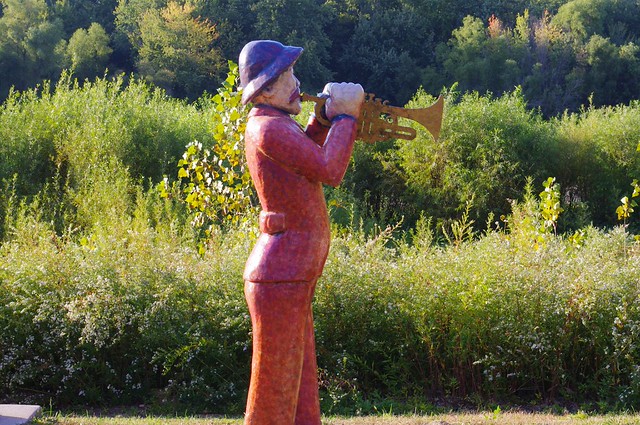
The statues are removed and stored during the winter and if the area is threatened with flooding.

One of the most recent fix-ups included a heavy-duty urethane coating, along with new bases and concrete pads.


Twilight at Martin Lake, Idaho, July 27, 2010
Martin Lake and nearby Bull Trout Lake are west of Stanley, Idaho at 6900 ft. in Boise National Forest. We were camped in Bull Trout campground, just a short walk from Martin Lake. The directions to this campground had been a little confusing and we had driven quite a few miles past it before realizing we had missed the turn.


