The man and woman on the right are my great-great-grandparents, James Wesley Goad and Olive Orabelle Wineland Goad, in front of their house in 1899, with his brothers, sisters, and their spouses.
Jim and Ollie Goad built a sod house about 1890 on their land three miles west, six miles north of Waldo, in Liberty Township. After it was completed, a steady stream of wagons was seen going to and from their home. On investigation, the sheriff found neighbors carrying Goad water home by the barrel. Many wells in early days produced only surface water, unpalatable and unsanitary. Jim and Ollie were happy to share with others less fortunate.
On Thursday, we came across a similar sod house at Ash Hollow State Park, Nebraska:
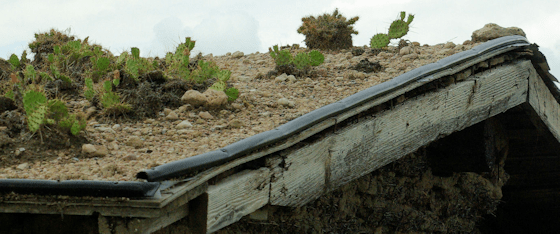
This soddie was built on 2 days in 1967 as part of the Ash Hollow Centennial Pageant, when a nearby sod house was reconstructed. On the prairies, other materials for construction were a good distance away. At Ash Hollow, the original homestead dwelling at this location had been built of stone.
Yes, there is stuff growing on the roof.
![]()
The inside was – well, it was a shelter from the elements.
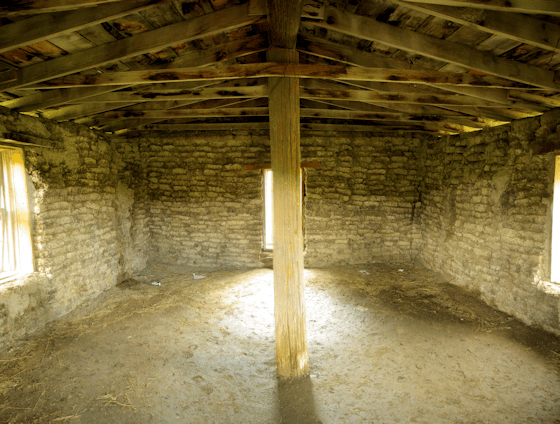
How would you like living in something like this?
{ 9 comments }
I would love to live in one of those places like the old timers did. All of us may well have to, perhaps two generations down the line!
@Rummuser
I dunno….I think after a few North Dakota winters, the novelty of a dirt buidling with no central heating or plumbing would start to wear thin!
I’m glad I don’t have to live in one, in my state as it would be quite muddy at times
hey, here by way of the Funster, Jannie
have a great day
That’s great that you have a family photo that old! Living in a house like that, I’d be worried about bugs.
Some of the problems with these old sod houses were (1) keeping things clean — in house made of dirt. (2) insects that liked to live in the soil (3) rodents that lived in the soil. The thickness of the walls, though, helped keep them cool in summer and warm in winter — at least relative to a tent or a dugout home.
Modern techniques could improve on the concept — rammed earth packed tight in forms and covered with some kind of impermeable concrete type material would match the insulation value of the thick walls.
I obtained the old photo from a 2nd or 3rd cousin when I was doing genealogical research.
It’s not for me Mike. I’ve seen more comfortable barns. It’s great that you managed to get hold of the pic though. I’ve done a little research into my ancestors but I haven’t been lucky enough to come across photos yet.
Cath – I quit doing any genealogical research about 8 or 9 years ago. This image and some other material does help me understand what some of these pioneers went through to make their own way in the world. An interesting family legend is that, in her younger years and not knowing who he was, danced a dance with an outlaw by the name of Jesse James. Possible, I guess, but unlikely.
Thanks for posting this, I first read about sod houses when I was around eight years old.
Laura Ingalls Wilder, in her Little House series, wrote about the sod house she and her family stayed in. Her Pa bought the house from a Swede. according to Laura’s Pa a lot of Swedes had sod houses/sod barns.
The sellers name escapes me at the moment; I believe he was moving further west. Laura painted a vivid account of life in that tiny sod house. I rember she wrote that if were traveling on the dirt road hear the house, you could have passed by it without knowing that there was a house there. The house was crafted into a small hill. In fact grass, and wild flowers grew on top of that hill.
Laura writes about this house in On the Banks of Plum Creek. Laura offers tidbits of the sodhouse throughout the entire book, including keeping the dirt floor clean with a willow broom.
Moondancer – You are certainly welcome.
I never read the Little House books, though my wife and daughters did. Of course, we watched the TV series.
Comments on this entry are closed.