Sacred Emily

by Gertrude Stein, 1913
(first appeared in Geography and Plays1)

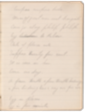
Sacred Emily Manuscript Notebook Page 1 at Yale University LibraryCompose compose beds.
Wives of great men rest tranquil.
Come go stay philip philip.
Egg be takers.
Parts of place nuts.
Suppose twenty for cent.
It is rose in hen.
Come one day.
A firm terrible a firm terrible hindering, a firm terrible hindering have a ray nor pin nor.
Egg in places.
Egg in few insists.
In set a place.
I am not missing.
Who is a permit.
I love honor and obey I do love honor and obey I do.
Melancholy do lip sing.
How old is he.
Murmur pet murmur pet murmur.
Push sea push sea push sea push sea push sea push sea push sea push sea.
Sweet and good and kind to all.
Wearing head.
Cousin tip nicely.
Cousin tip.
Nicely.
Wearing head.
Leave us sit.
I do believe it will finish, I do believe it will finish.
Pat ten patent, Pat ten patent.
Eleven and eighteen.
Foolish is foolish is.
Birds measure birds measure stores birds measure
stores measure birds measure.
Exceptional firm bites.
How do you do I forgive you everything and there is nothing to forgive.
Never the less.
Leave it to me.
Weeds without papers.
Weeds without papers are necessary.
Left again left again.
Exceptional considerations.
Never the less tenderness.
Resting cow curtain.
Resting bull pin.
Resting cow curtain.
Resting bull pin.
Next to a frame.
The only hat hair.
Leave us mass leave us.  Leave us pass.  Leave us. Leave us pass leave us.
Humming is.
No climate.
What is a size.
Ease all I can do.
Colored frame.
Couple of canning.
Ease all I can do.
Humming does as
Humming does as humming is.
What is a size.
No climate.
Ease all I can do.
Shall give it, please to give it.
Like to give it, please to give it.
What a surprise.
Not sooner whether.
Cordially yours.
Pause.
Cordially yours.
Not sooner together.
Cordially yours.
In strewing, in strewing.
That is the way we are one and indivisible.
Pay nuts renounce.
Now without turning around.
I will give them to you tonight.
Cunning is and does cunning is and does the most
beautiful notes.
I would like a thousand most most.
Center pricking petunia.
Electrics are tight electrics are white electrics are
a button.
Singular pressing.
Recent thimble.
Noisy pearls noisy pearl coat.
Arrange.
Arrange wide opposite.
Opposite it.
Lily ice-cream.
Nevertheless.
A hand is Willie.
Henry Henry Henry.
A hand is Henry.
Henry Henry Henry.
A hand is Willie.
Henry Henry Henry.
All the time.
A wading chest.
Do you mind.
Lizzie do you mind.
Ethel.
Ethel.
Ethel.
Next to barber.
Next to barber bury.
Next to barber bury china.
Next to barber bury china glass.
Next to barber china and glass.
Next to barber and china.
Next to barber and hurry.
Next to hurry.
Next to hurry and glass and china.
Next to hurry and glass and hurry.
Next to hurry and hurry.
Plain cases for see.
Tickle tickle tickle you for education.
A very reasonable berry.
Suppose a selection were reverse.
Cousin to sadden.
A coral neck and a little song so very extra so very
Susie.
Cow come out cow come out and out and smell a
little.
Draw prettily.
Next to a bloom.
Neat stretch.
Place plenty.
Cauliflower.
Cauliflower.
Curtain cousin.
Apron.
Neither best set.
Do I make faces like that at you.
Pinkie.
Not writing not writing another.
Another one.
Think.
Jack Rose Jack Rose.
Yard.
Practically all of them.
Does believe it.
Measure a measure a measure or.
Which is pretty which is pretty which is pretty.
To be top.
Neglect Waldberg.
Sudden say separate.
So great so great Emily.
Sew grate sew grate Emily.
Not a spell nicely.
Ring.
Weigh pieces of pound.
Aged steps.
Stops.
Not a plan bow.
Why is lacings.
Little slam up.
Cold seam peaches.
Begging to state begging to state begging to state
alright.
Begging to state begging to state begging to state
alright.
Wheels stows wheels stows.
Wickedness.
Cotton could mere less.
Nevertheless.
Anne.
Analysis.
From the standpoint of all white a week is none too much.
Pink coral white coral, coral coral.
Happy happy happy.
All the, chose.
Is a necessity.
Necessity.
Happy happy happy all the.
Necessity.
Remain seated.
Come on come on come on on.
All the close.
Remain seated.
Happy.
All the.
Necessity.
Remain seated.
All the, close.
Websters and mines, websters and mines.
Websters and mines.
Trimming.
Gold space gold space of toes.
Twos, twos.
Pinned to the letter.
In accompany.
In a company in.
Received.
Must.
Natural lace.
Spend up.
Spend up length.
Spend up length.
Length thoroughly.
Neatness.
Neatness Neatness.
Excellent cording.
Excellent cording short close.
Close to.
When.
Pin black.
Cough or up.
Shouting.
Shouting.
Neater pin.
Pinned to the letter.
Was it a space was it a space was it a space to see.
Neither things.
Persons.
Transition.
Say say say.
North of the calender.
Window.
Peoples rest.
Preserve pulls.
Cunning piler.
Next to a chance.
Apples.
Apples.
Apples went.
It was a chance to preach Saturday.
Please come to Susan.
Purpose purpose black.
Extra plain silver.
Furious slippers.
Have a reason.
Have a reason candy.
Points of places.
Neat Nezars.
Which is a cream, can cream.
Ink of paper slightly mine breathes a shoulder able
shine.
Necessity.
Near glass.
Put a stove put a stove hoarser.
If I was surely if I was surely.
See girl says.
All the same bright.
Brightness.
When a churn say suddenly when a churn say suddenly.
Poor pour percent.
Little branches.
Pale.
Pale.
Pale.
Pale.
Pale.
Pale.
Pale.
Near sights.
Please sorts.
Example.
Example.
Put something down.
Put something down some day.
Put something down some day in.
Put something down some day in my.
In my hand.
In my hand right.
In my hand writing.
Put something down some day in my hand writing.
Needles less.
Never the less.
Never the less.
Pepperness.
Never the less extra stress.
Never the less.
Tenderness.
Old sight.
Pearls.
Real line.
Shoulders.
Upper states.
Mere colors.
Recent resign.
Search needles.
All a plain all a plain show.
White papers.
Slippers.
Slippers underneath.
Little tell.
I chance.
I chance to.
I chance to to.
I chance to.
What is a winter wedding a winter wedding.
Furnish seats.
Furnish seats nicely.
Please repeat.
Please repeat for.
Please repeat.
This is a name to Anna.
Cushions and pears.
Reason purses.
Reason purses to relay to relay carpets.
Marble is thorough fare.
Nuts are spittoons.
That is a word.
That is a word careless.
Paper peaches.
Paper peaches are tears.
Rest in grapes.
Thoroughly needed.
Thoroughly needed signs.
All but.
Relieving relieving.
Argonauts.
That is plenty.
Cunning saxon symbol.
Symbol of beauty.
Thimble of everything.
Cunning clover thimble.
Cunning of everything.
Cunning of thimble.
Cunning cunning.
Place in pets.
Night town.
Night town a glass.
Color mahogany.
Color mahogany center.
Rose is a rose is a rose is a rose.
Loveliness extreme.
Extra gaiters.
Loveliness extreme.
Sweetest ice-cream.
Page ages page ages page ages.
Wiped Wiped wire wire.
Sweeter than peaches and pears and cream.
Wiped wire wiped wire.
Extra extreme.
Put measure treasure.
Measure treasure.
Tables track.
Nursed.
Dough.
That will do.
Cup or cup or.
Excessively illigitimate.
Pussy pussy pussy what what.
Current secret sneezers.
Ever.
Mercy for a dog.
Medal make medal.
Able able able.
A go to green and a letter spoke a go to green or
praise or
Worships worships worships.
Door.
Do or.
Table linen.
Wet spoil.
Wet spoil gaiters and knees and little spools little spools or ready silk lining.
Suppose misses misses.
Curls to butter.
Curls.
Curls.
Settle stretches.
See at till.
Louise.
Sunny.
Sail or.
Sail or rustle.
Mourn in morning.
The way to say.
Patter.
Deal own a.
Robber.
A high b and a perfect sight.
Little things singer.
Jane.
Aiming.
Not in description.
Day way.
A blow is delighted.
This is a long abstract poem2, probably most famous for the phrase “A rose is a rose is a rose.”

Some believe the poem to be a dedication by Gertrude Stein to her life partner, Alice B. Toklas.


Gertrude Stein3 (February 3, 1874 – July 27, 1946) was an American novelist, poet, playwright, and art collector. Born in Pittsburgh, Pennsylvania, in the Allegheny West neighborhood and raised in Oakland, California, Stein moved to Paris in 1903, and made France her home for the remainder of her life. With her partner, Alice B. Toklas4, she hosted a Paris salon, where the leading figures of modernism in literature and art, such as Pablo Picasso, Ernest Hemingway, F. Scott Fitzgerald, Sinclair Lewis, Ezra Pound, Sherwood Anderson and Henri Matisse, would meet.

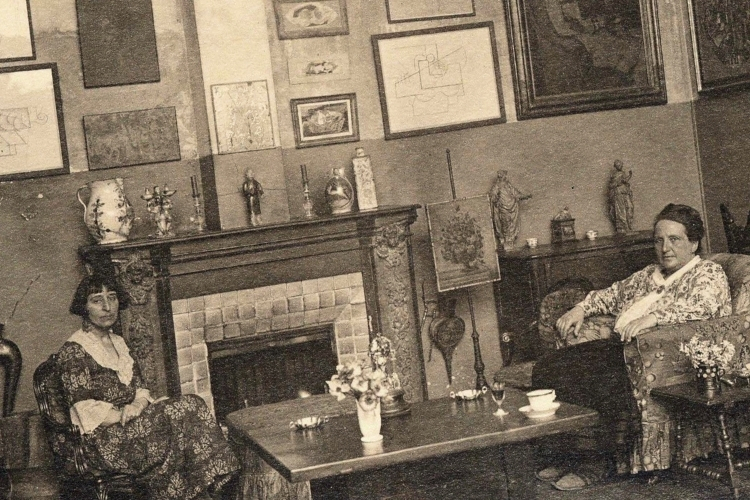
Gertrude Stein (left) and Alice B. Toklas, 1934. (click for larger version)In 1933, Stein published a quasi-memoir of her Paris years, The Autobiography of Alice B. Toklas, written in the voice of Alice B. Toklas, her life partner. The book became a literary bestseller and vaulted Stein from the relative obscurity of the cult-literature scene into the limelight of mainstream attention. Two quotes from her works have become widely known: “Rose is a rose is a rose is a rose,” and “there is no there there”, with the latter often taken to be a reference to her childhood home of Oakland.


References and Interpretations on Stein


Endnotes

  1. Stein, Gertrude. Geography and Plays. Boston, Mass.: The Four Seas Company, 1922.
  2. Abstract poem, a term coined by Edith Sitwell to describe a poem in which the words are chosen for their aural quality rather than specifically for their sense or meaning. Britanica
  3. “Gertrude Stein.” Wikipedia. last edit August 2, 2021. accessed August 4, 2021, https://en.wikipedia.org/wiki/Gertrude_Stein.
  4. “Alice B. Toklas.” Wikipedia. last edit July 23, 2021. accessed August 6, 2021, https://en.wikipedia.org/wiki/Alice_B._Toklas.

.


0 comments

To Marguerite

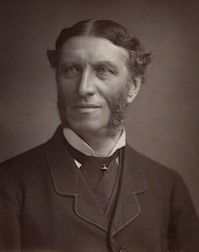
We mortal millios live alone (from To Marguerite by Matthew Arnold)Matthew Arnold

YES: in the sea of life enisled,

With echoing straits between us thrown.

Dotting the shoreless watery wild,

We mortal millions live alone.

     The islands feel the enclasping flow,

And then their endless bounds they know.

.

But when the moon their hollows lights,

And they are swept by balms of spring,

And in their glens, on starry nights,

The nightingales divinely sing;

And lovely notes, from shore to shore,

Across the sounds and channels pour;

.

Mathew Arnold1

O then a longing like despair

Is to their farthest caverns sent!

—For surely once, they feel, we were

Parts of a single continent.

Now round us spreads the watery plain—

O might our marges meet again!

.

Who order’d that their longing’s fire

Should be, as soon as kindled, cool’d?

Who renders vain their deep desire?—

     A God, a God their severance ruled;

And bade betwixt their shores to be

The unplumb’d, salt, estranging sea.

……..


The poem was first published with the title To Marguerite, in Returning a Volume of the Letters of Ortis in 1852 in a volume titled Empedocles on Etna and other Poems, published anonymously. The volume is very scarce and was withdrawn from circulation before fifty copies were sold. In 1857, the poem was published as To Marguerite: Continued, a sequel to the poem Isolation: To Marguerite.1

……

The punctuation and formatting used for the poem on this page is from an 1896 compilation of Arnold’s poetry.2

Glossary

  • Enisl’d; ​to make into an island
  • Enclasping: ​to clasp or hold in an embrace
  • Balms: ​a substance which soothes
  • Marges: ​edges, margins
  • Severance: ​breaking apart
  • Bade: ​ordered
  • Betwixt: ​between
  • Unplumb’d: ​a depth which cannot be measured
  • Estranging: ​pushing apart

References and Interpretations

Biographical information on Matthew Arnold


  1. Elliott & Fry. Matthew Arnold. c. 1883. National Portait Gallery, London. In National Portrai Gallery.
  2. To Marguerite: Continued. Wikipedia. last edit February 02, 2016. Accessed July 11, 2019.
  3. Arnold, Matthew. To Margurite, In Returning a Volume of the Letters of Ortis. In Alaric at Rome: And Other Poems, edited by Clement K. Shorter, 170. London: Ward, Lock & Bowden, 1896.

0 comments

The Song of Callicles

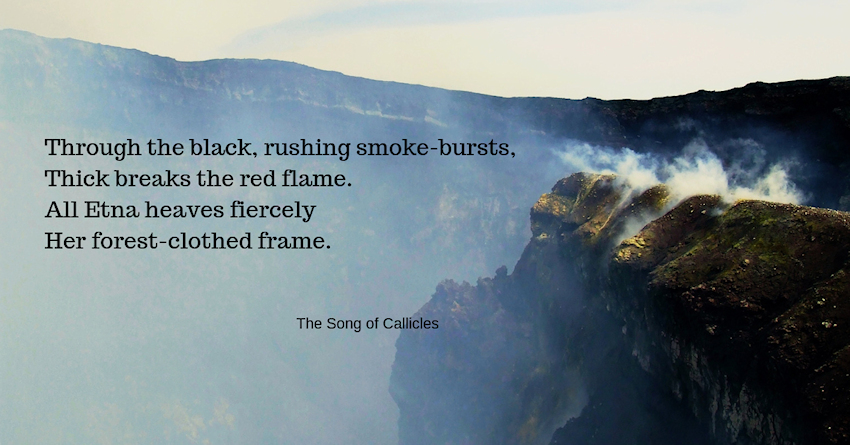
Mt Etna ---Through the black, rushing smoke-bursts,  Thick breaks the red flame.  All Etna heaves fiercely  Her forest-clothed frame.

Matthew Arnold
(from Empedocles on Etna1)

Through the black, rushing smoke-bursts,

Thick breaks the red flame.

All Etna heaves fiercely

Her forest-clothed frame.

Not here, O Apollo!

Are haunts meet for thee.

But, where Helicon breaks down

In cliff to the sea.

Where the moon-silver’d inlets

Send far their light voice

Up the still vale of Thisbe,

O speed, and rejoice!

On the sward at the cliff-top,

Lie strewn the white flocks;

On the cliff-side, the pigeons

Roost deep in the rocks.

In the moonlight the shepherds,

Soft lull’d by the rills,

Lie wrapt in their blankets,

Asleep on the hills.

Matthew Arnold

Matthew Arnold2

—What forms are these coming

So white through the gloom?

What garments out-glistening

The gold-flower’d broom?

What sweet-breathing Presence

Out-perfumes the thyme?

What voices enrapture

The night’s balmy prime?—

‘Tis Apollo comes leading

His choir, The Nine.

—The Leader is fairest,

But all are divine.

They are lost in the hollows.

They stream up again.

What seeks on this mountain

The glorified train?—

They bathe on this mountain,

In the spring by their road.

Then on to Olympus,

Their endless abode.

—Whose praise do they mention,

Of what is it told?—

What will be for ever.

What was from of old.

First hymn they the Father

Of all things: and then,

The rest of Immortals,

The action of men.

The Day in his hotness,

The strife with the palm;

The Night in her silence,

The Stars in their calm.


Biographical information on Matthew Arnold


  1. Empedocles on Etna, a dramatic poem by Matthew Arnold, was published anonymously in 1852.  The poem is based on legends around the death of Empedocles (c. 490–430 BCE), a Greek philosopher and statesman. Portrayed as a man with no joy, who feels useless intellectually and politically, he plans to kill himself by leaping into the Mt. Etna volcano.  Two friends Pausanias, a physician, and Callicles, a young Harp-player, try to live his depression, to no avail. The Song of Callicles  begins just after Empedocles has thrown himself into the crater. – “Empedocles on Etna.” Encyclopaedia Britannica. March 28, 2011. Accessed June 29, 2019. https://www.britannica.com/topic/Empedocles-on-Etna
  2. Elliott & Fry. Matthew Arnold. c. 1883. National Portait Gallery, London. In National Portrai Gallery. https://www.npg.org.uk/collections/search/portraitLarge/mw115288/Matthew-Arnold.


0 comments

Brignall Banks

Sir Walter Scott

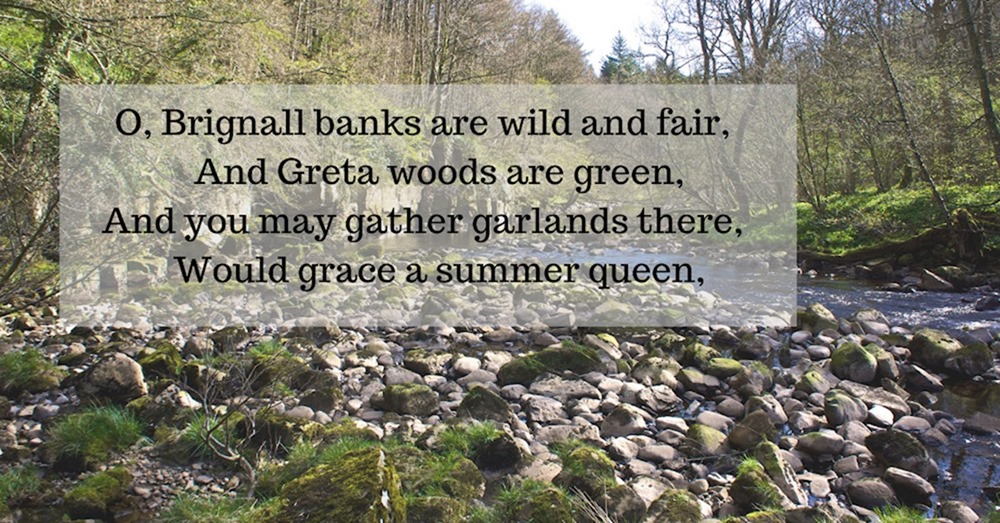
O, Brignall banks are wild and fair, And Greta woods are green, And you may gather garlands there, Would grace a summer queen

River Greta, near Brignall, County Durham. Great Britain1

(From Rokeby, A Poem,2 page 125)

SONG
.
O, Brignall banks3 are wild and fair,
And Greta woods are green,
And you may gather garlands there,
Would grace a summer queen:
And as I rode by Dalton Hall,
Beneath the turrets high,
A Maiden on the castle wall
Was singing merrily:
.
‘O, Brignall banks are fresh and fair,
And Greta woods are green!
I’d rather rove with Edmund there
Than reign our English Queen.’
.
‘If, Maiden, thou wouldst wend with me
To leave both tower and town,
Thou first must guess what life lead we,
That dwell by dale and down:
And if thou canst that riddle read,
As read full well you may,
Then to the green-wood shalt thou speed
As blithe as Queen of May.’
.
chorus
.
Yet sung she, ‘Brignall banks are fair,
And Greta woods are green!
I’d rather rove with Edmund there
Than reign our English Queen.
.
‘I read you by your bugle horn
And by your palfrey good,
I read you for a Ranger sworn
To keep the King’s green-wood.’
‘A Ranger, Lady, winds his horn,
And ’tis at peep of light;
His blast is heard at merry morn,

And mine at dead of night.’.

chorus
.
Yet sung she, ‘Brignall banks are fair,
And Greta woods are gay!
I would I were with Edmund there,
To reign his Queen of May!
‘With burnish’d brand and musketoon
So gallantly you come,
I read you for a bold Dragoon,
That lists the tuck of drum.’
‘I list no more the tuck of drum,
No more the trumpet hear;
But when the beetle sounds his hum,

My comrades take the spear..

chorus
.
‘And O! though Brignall banks be fair,
And Greta woods be gay,
Yet mickle must the maiden dare,
Would reign my Queen of May!
.
‘Maiden! a nameless life I lead,
A nameless death I’ll die;
The fiend whose lantern lights the mead
Were better mate than I!
And when I’m with my comrades met
Beneath the green-wood bough,
What once we were we all forget,

Nor think what we are now.’.

chorus
.
Yet Brignall banks are fresh and fair,
And Greta woods are green,
And you may gather flowers there
Would grace a summer queen.

Footnotes

  1. Cunningham, Paul. River Greta, Nearr Brignall. April 16, 2014. In Geograph. June 7, 2014. Accessed June 29, 2019. https://www.geograph.org.uk/photo/4016701. licensed for reuse under (CC BY-SA 2.0) Creative Commons License (Note, that license and its provisions also applies to the image as used here.)
  2. Scott, Walter. Rokeby; A Poem. John Ballentine and Co., Edinburgh, 1813.
  3. (From Rokeby, page xxix) What follows is an attempt to describe the romantic glen, or rather ravine, through which the Greta finds a passage between Rokeby and Mortham, the former situated upon the left bank of Greta, the latter on the right bank, about half a mile nearer to its junction with the Tees. The river runs with very great rapidity over a bed of solid rock, broken by many shelving descents, down which the stream dashes with great noise and impetuosity, vindicating its etymology, which has been derived from the Gothic, gridan, to clamour. The banks partake of the same wild and romantic character, being chiefly lofty cliffs of limestone rock, whose grey colour contrasts admirably with the various trees and shrubs which find root among their crevices, as well as with the hue of the ivy, which clings around them in profusion, and hangs down from their .projections in long sweeping tendrils. At other points the rocks give place to precipitous banks of earth, bearing large trees, intermixed with copse-wood. In one spot the dell, which is elsewhere very narrow, widens for a space to leave room for a dark grove of yew-trees, intermixed here and there with aged pines of uncommon size. Directly opposite to this sombre thicket, the cliffs on the other side of the Greta are tall, white, and fringed with all kinds of deciduous shrubs. The whole scenery of this spot is so much adapted to the ideas of superstition, that it has acquired the name of Blockula, from the place where the Swedish witches were supposed to hold their sabbath. The dell, however, has superstitions of its own growth, for it is supposed to be haunted by a female spectre, called the Dobie of Mortham. The cause assigned for her appearance is a lady’s having been whilom murdered in the wood, in evidence of which her blood is shewn upon the stairs of the old tower at Mortham. But whether she was slain by a jealous husband or by savage banditti, or by an uncle who coveted her estate, or by a rejected lover, are points upon which the traditions of Rokeby do not enable us to decide.
  4. Raeburn, Sir Henry. “Sir Walter Scott.” Wikimedia, Wikimedia Foundation, 4 Mar. 2013, National Galleries of Scotland, Edinburgh, UK, commons.wikimedia.org/wiki/File:Sir_Henry_Raeburn_-_Portrait_of_Sir_Walter_Scott.jpg.

Biographical information on Sir Walter Scott


0 comments

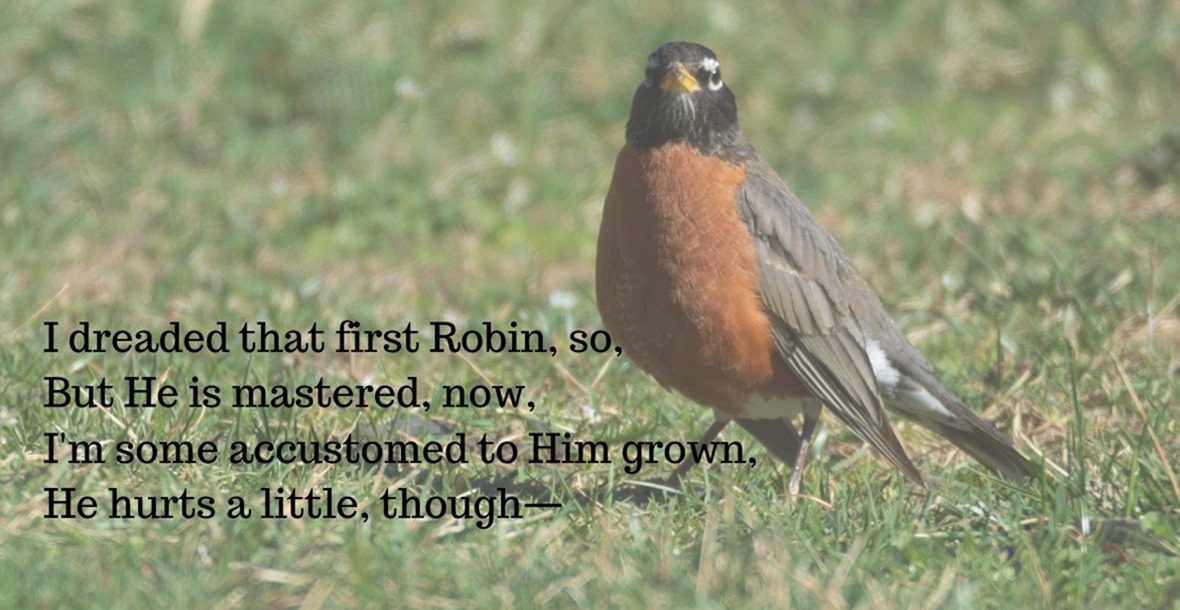
I dreaded that first Robin, so,

Emily Dickinson

I dreaded that first Robin, so

I dreaded that first Robin, so,
But He is mastered, now,
I’m some accustomed to Him grown,
He hurts a little, though—

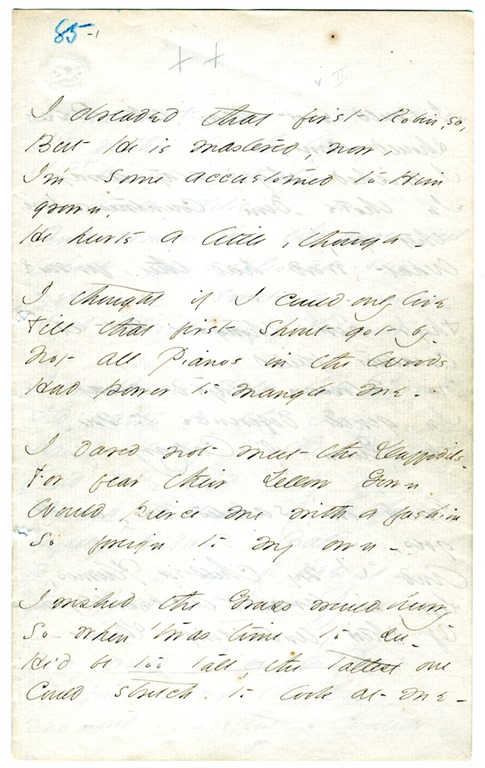
I thought if I could only live
Till that first Shout got by—
Not all Pianos in the Woods
Had power to mangle me—

I dared not meet the Daffodils—
For fear their Yellow Gown
Would pierce me with a fashion
So foreign to my own—

I wished the Grass would hurry—
So—when ’twas time to see—
He’d be too tall, the tallest one
Could stretch—to look at me—

I could not bear the Bees should come,
I wished they’d stay away
In those dim countries where they go,
What word had they, for me?

They’re here, though; not a creature failed—
No Blossom stayed away
In gentle deference to me—
The Queen of Calvary—

Each one salutes me, as he goes,
And I, my childish Plumes,
Lift, in bereaved acknowledgement
Of their unthinking Drums—

I dreaded that first Robin


References and Interpretations

Biographical information on Emily Dickenson

Image credits and info

0 comments

Sir Patrick Spens

2 versions
Anonymous

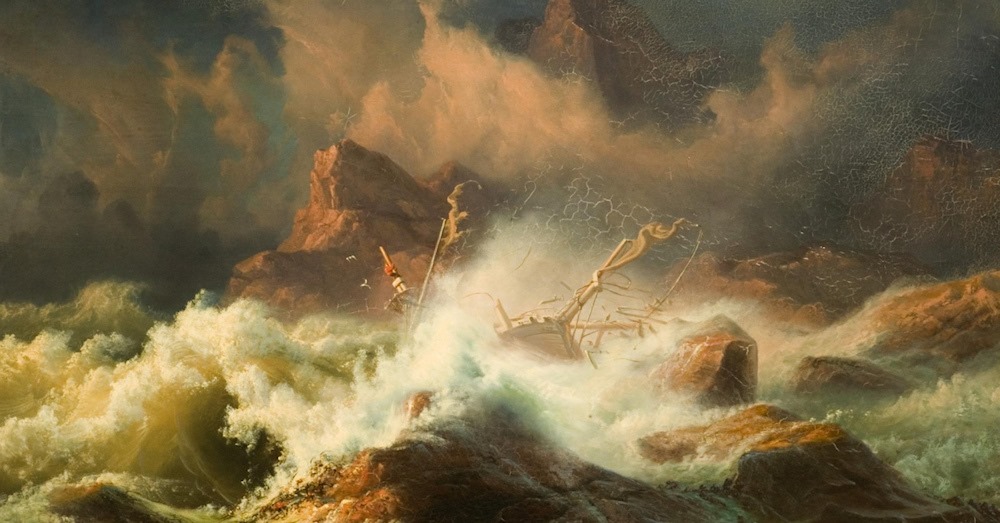
The Wreck by Knude Andreassen Baade


Version 1

The king sits in Dunfermline toune
Drinking the blude reid wine,
‘O whar will I get skeely sailor,
To sail this ship o’ mine?’

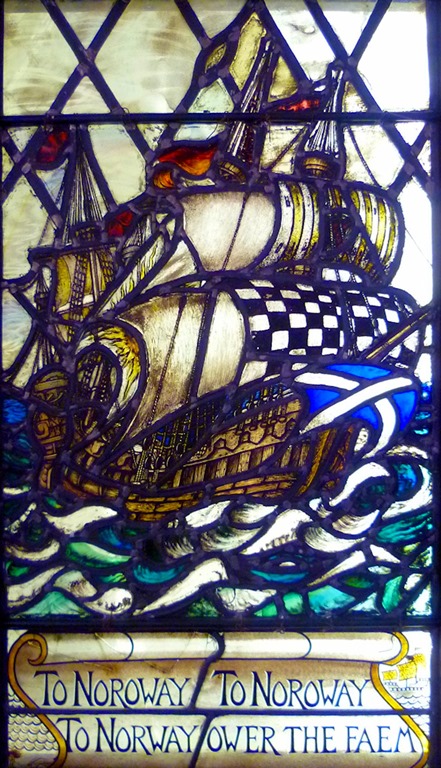
Sir Patrick Spens window, Abbot House, Dunfermline, ScotlandUp and spak an eldern knicht,
Sat at the kings richt kne:
‘Sir Patrick Spens is the best sailor
That sails upon the se.’

The king has written a braid letter,
And signed it wi his hand,
And sent it to Sir Patrick Spens,
Was walking on the strand.

To Noroway! to Noroway!
to Noroway oer the faem!
The king’s daughter to Noroway
‘Tis thou maun bring her hame.

The first line that Sir Patrick red,
A loud lauch lauched he;
The next line that Sir Patrick red,
The teir blinded his ee.

‘O wha is this has don this deid,
This ill deid don to me,
To send me out this time o’ the yeir,
To sail upon the se! ‘

‘Mak haste, mak haste, my mirry men,
Our guid ship sails the morne:’
‘O say na sae, my master deir,
I feir a deadlie storme.

‘Yestereen I saw the new moone,
Wi the auld moone in hir arme,
And I feir, I feir, my master deir ,
That we will cum to harme.’

O loth, o loth,
The Scots lords were
To weet their cork-heild schoone;
Bot lang owre a’ the play were playd,
Thair hats they swam aboone.

O lang, lang may their ladies sit,
Wi their fans into their hand,
Or ere they se Sir Patrick Spens
Cum sailing to the strand.

O lang, lang may the ladies stand,
Wi thair gold kems in their hair,
Waiting for thair ain deir lords,
For they’ll se thame na mair.

Haf owre, haf owre to Aberdour,
It’s fiftie fadom deip,
And thair lies guid Sir Patrick Spens,
Wi the Scots lords at his feit.


Version 2

I. The Sailing
THE king sits in Dunfermline town
Drinking the blude-red wine;
‘O whare will I get a skeely skipper
To sail this new ship o’ mine?’

O up and spak an eldern knight,
Sat at the king’s right knee;
‘Sir Patrick Spens is the best sailor
That ever sail’d the sea.’

Our king has written a braid letter,
And seal’d it with his hand,
And sent it to Sir Patrick Spens,
Was walking on the strand.

‘To Noroway, to Noroway,
To Noroway o’er the faem;
The king’s daughter o’ Noroway,
‘Tis thou must bring her hame.’

The first word that Sir Patrick read
So loud, loud laugh’d he;
The neist word that Sir Patrick read
The tear blinded his e’e.

‘O wha is this has done this deed
And tauld the king o’ me,
To send us out, at this time o’ year,
To sail upon the sea?

‘Be it wind, be it weet, be it hail, be it sleet,
Our ship must sail the faem;
The king’s daughter o’ Noroway,
‘Tis we must fetch her hame.’

They hoysed their sails on Monenday morn
Wi’ a’ the speed they may;
They hae landed in Noroway
Upon a Wodensday.

II. The Return

‘Mak ready, mak ready, my merry men a’!
Our gude ship sails the morn.’
‘Now ever alack, my master dear,
I fear a deadly storm.

‘I saw the new moon late yestreen
Wi’ the auld moon in her arm;
And if we gang to sea, master,
I fear we’ll come to harm.’

They hadna sail’d a league, a league,
A league but barely three,
When the lift grew dark, and the wind blew loud,
And gurly grew the sea.

The ankers brak, and the topmast lap,
It was sic a deadly storm:
And the waves cam owre the broken ship
Till a’ her sides were torn.

‘Go fetch a web o’ the silken claith,
Another o’ the twine,
And wap them into our ship’s side,
And let nae the sea come in.’

They fetch’d a web o’ the silken claith,
Another o’ the twine,
And they wapp’d them round that gude ship’s side,
But still the sea came in.

O laith, laith were our gude Scots lords
To wet their cork-heel’d shoon;
But lang or a’ the play was play’d
They wat their hats aboon.

And mony was the feather bed
That flatter’d on the faem;
And mony was the gude lord’s son
That never mair cam hame.

O lang, lang may the ladies sit,
Wi’ their fans into their hand,
Before they see Sir Patrick Spens
Come sailing to the strand!

And lang, lang may the maidens sit
Wi’ their gowd kames in their hair,
A-waiting for their ain dear loves!
For them they’ll see nae mair.

Half-owre, half-owre to Aberdour,
‘Tis fifty fathoms deep;
And there lies gude Sir Patrick Spens,
Wi’ the Scots lords at his feet!


“Sir Patrick Spens” is one of the most popular of the Child Ballads (No. 58) (Roud 41), and is of Scottish origin. It is a maritime ballad about a disaster at sea.  Wikipedia

References and Interpretations

Image Credit


    0 comments

    In The Garden

    (A Bird came down the Walk1)

    Emily Dickinson

    A Bird came down the Walk (Pixabay image 114895 by SimonaR) A bird came down the walk:
    He did not know I saw;
    He bit an angle-worm in halves
    And ate the fellow, raw.
    And then he drank a dew
    From a convenient grass,
    And then hopped sidewise to the wall
    To let a beetle pass.
    He glanced with rapid eyes
    That hurried all abroad,—
    They looked like frightened beads, I thought;
    He stirred his velvet head
    Like one in danger; cautious,
    I offered him a crumb,
    And he unrolled his feathers
    And rowed him softer home
    Than oars divide the ocean,
    Too silver for a seam,
    Or butterflies, off banks of noon,
    Leap, plashless,1 as they swim.

    Online early versions

    References and Interpretations

    Biographical information on Emily Dickenson

    All of these sources were accessed June 25, 2019.


    1. Punctuation and titles – The original 1862 poem had no title, very little punctuation, and unconventional capitalization.  In its first publication, Emily Dickenson’s Letters, T. W. Higginson gave it the benefit of “ordinary usages” of punctuation.  A title, In the Garden, was added in a 1920 publication edited by Thomas Wentworth Higginson and  ‎Mabel Loomis Todd.
    2. plashless, adv. Smoothly; fluidly; deftly; elegantly; gracefully; in a flowing manner; without splashing; without disturbing the surface of the water. – Emily Dickinson Lexicon; Brigham Young University (accessed June 25, 2019)

    Image credit: Pixabay image 114895 by SimonaR


    0 comments

    Ozymandias

    Percy Bysshe Shelley

    I MET a Traveller from an antique land
    Who said: Two vast and trunkless legs of stone
    Stand in the desert. Near them on the sand,
    Half sunk, a shattered visage lies, whose frown,
    And wrinkled lip, and sneer of cold command,
    Tell that its sculptor well those passions read,
    Which yet survive, stamped on these lifeless things,
    The hand that mocked them and the heart that fed:
    And on the pedestal these words appear:
    “My name is Ozymandias, king of kings:
    Look on my works, ye Mighty, and despair!”
    Nothing beside remains. Round the decay
    Of that colossal wreck, boundless and bare,
    The lone and level sands stretch far away.

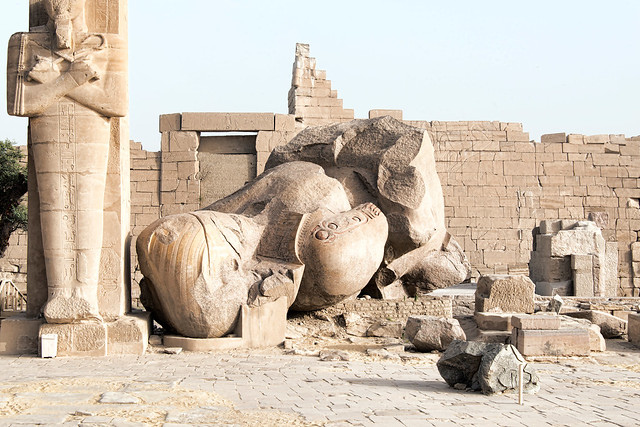
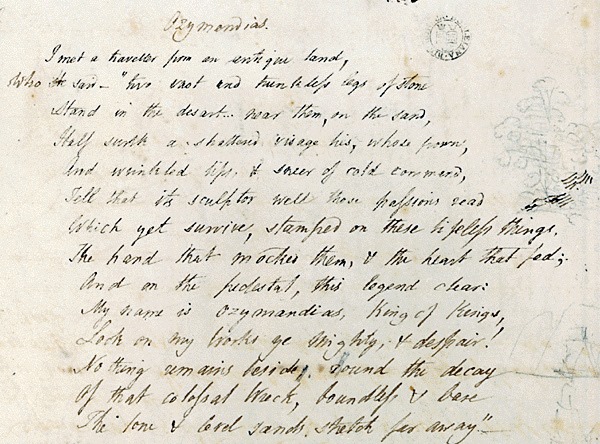
    The Ozymandias ColossusThe Ozymandias Colossus1

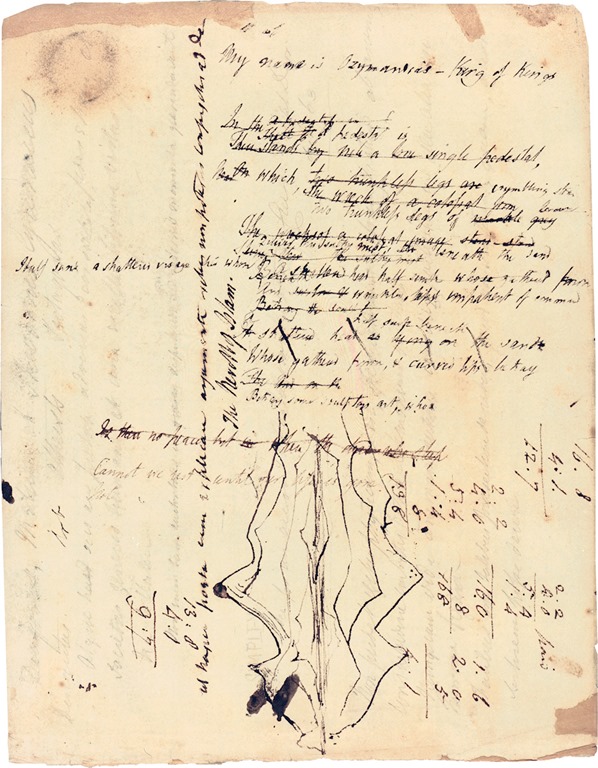
    Ozymandias 1817 draft
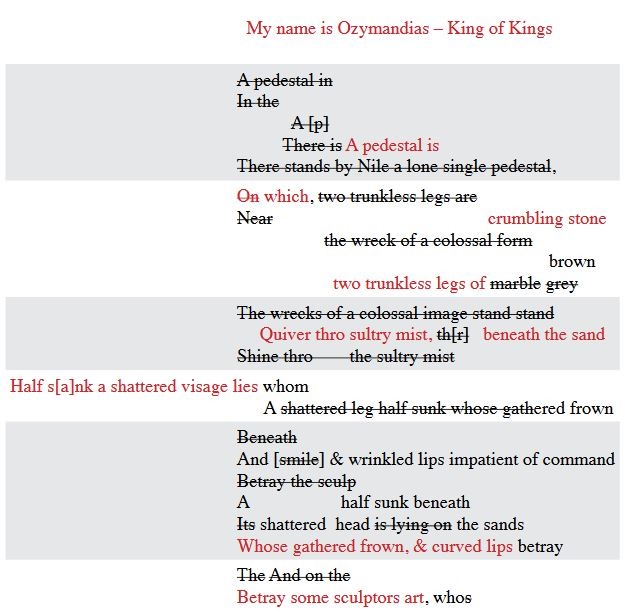
    Draft of Ozymandias (above) with transcript(below)2

    transcript of Ozymandias 1817 draft

    Ozymandias draft
    1817 fair copy

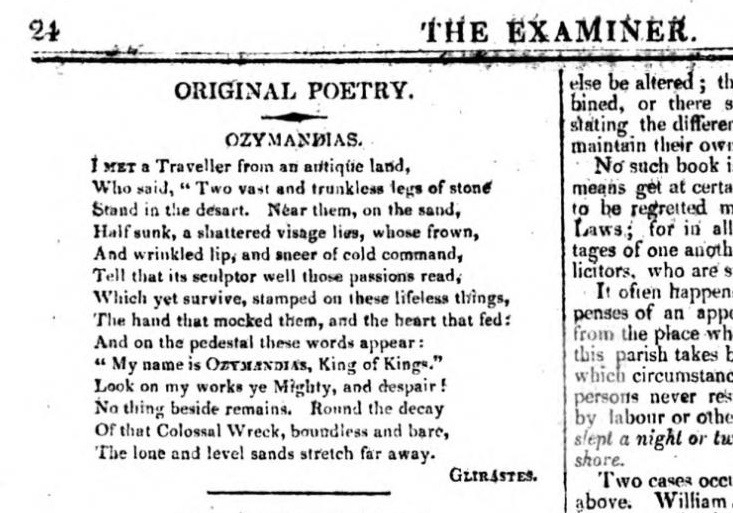
    Ozymandias_The_Examiner_1818

    First Publication3

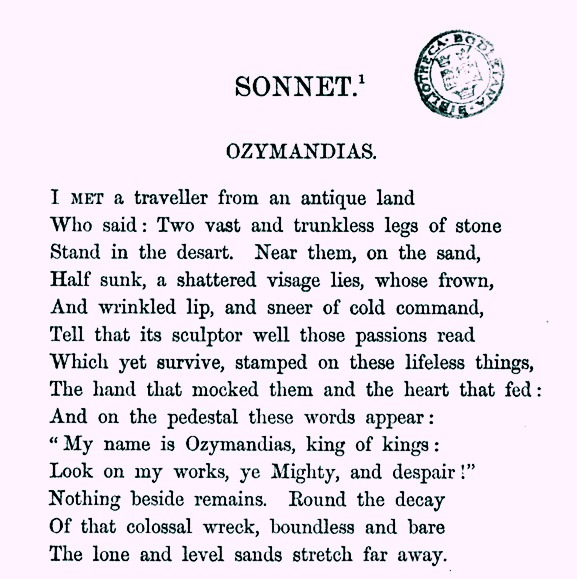
    Ozymandias

    1819 Publication4


    References and Interpretations


    1. The Ozymandias Colossus – Image on Flickr by Christopher Michel; 20389619045_70659004d4_oSome rights reserved
    2. 1817 draft of Ozymandias – Bodleian Library, Oxford, UK
    3. 11 January 1818 issue of The Examiner
    4. Shelley’s collection Rosalind and Helen, A Modern Eclogue; with Other Poems (1819)

    0 comments

    Fire and Ice

    Robert Frost

    SOME say the world will end in fire;
                 Some say in ice.
    From what I’ve tasted of desire
    I hold with those who favor fire.
            But if it had to perish twice,
    I think I know enough of hate
            To know that for destruction ice
    Is also great,
            And would suffice.

    Fire and IceBurning ice cubes on black background, DAPA Images, from Canva.com
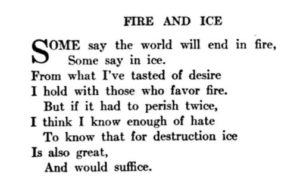

    Fire and Ice by Robert Frost

    Harper’s Magazine, Volume 142, December 1920, page 67

    References and Interpretations


    0 comments

    Sonnet 18

    William Shakespeare

    SHall I compare thee to a summer’s day?
    Thou art more lovely and more temperate:
    Rough winds do shake the darling buds of May,
    And summer’s lease hath all too short a date:
    Sometime too hot the eye of heaven shines,
    And often is his gold complexion dimm’d;
    And every fair from fair sometime declines,
    By chance or nature’s changing course untrimm’d:
    But thy eternal summer shall not fade
    Nor lose possession of that fair thou owest;
    Nor shall Death brag thou wander’st in his shade,
    When in eternal lines to time thou growest:
             So long as men can breathe or eyes can see,
             So long lives this and this gives life to thee


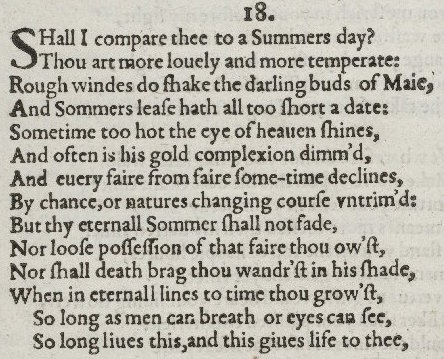
    Sonnet 18 in the 1609 Quarto of Shakespeare's sonnets

    Sonnet 18 in the 1609 Quarto of Shakespeare’s sonnets

    References and interpretations:


    0 comments